
0 m · Surface · People of Mexico · Oaxaca
Zapotec Art: Ancient Stone Designs and the Print Workshops of Oaxaca
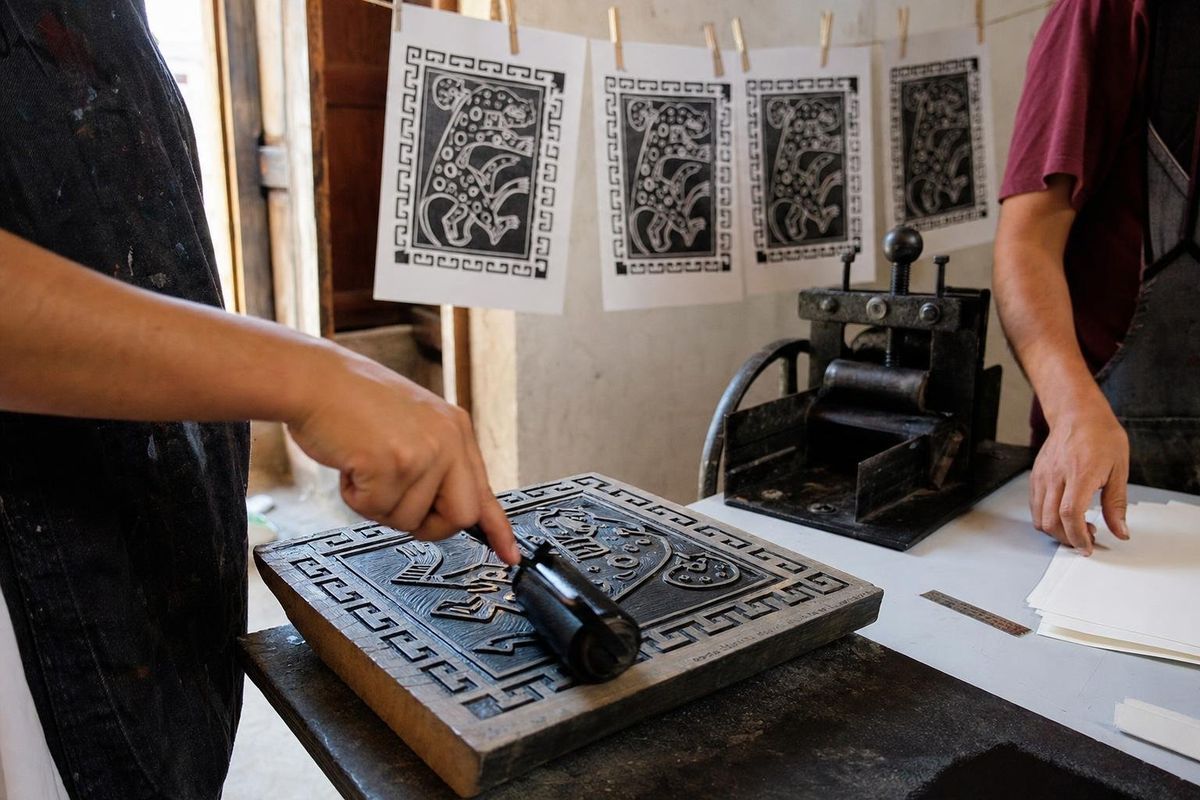
Zapotec art spans more than two and a half thousand years, from the carved stones of Monte Albán and the stone mosaics of Mitla to the paintings, prints, rugs and carvings made in Oaxaca today. The Zapotecs, who call themselves Bènizàa or a related name depending on the language variety, are one of Mexico's largest Indigenous peoples, and their designs remain everywhere in Oaxaca city and the villages around it.
Ancient Zapotec art
The oldest monumental Zapotec art is in stone. At Monte Albán, the carved slabs known as the Danzantes, from roughly 500 BC onward, show human figures in contorted poses, now widely read as captives. Later carvings record place names and conquests with glyphs, part of one of the earliest writing systems in the Americas.
Clay was just as important. Zapotec potters made grey ceramic funerary urns in the shape of seated figures wearing towering headdresses, often identified with deities. The most recognizable is the rain and lightning god usually called Cocijo, with a forked tongue and a mask-like face. Urns like these were placed in tombs, and museums in Oaxaca and Mexico City hold large collections.
Painting survives in tombs at Monte Albán, where processions of richly dressed figures and calendar signs cover the walls, and in the red painted lintels at Mitla, which share a style with the painted books of the late period.
Zapotec designs that carried on
The design most associated with Zapotec art is the stepped fret, the greca. At Mitla it covers entire walls in panels of cut stone. Writers often link it to the xicalcoliuhqui, a Mesoamerican motif read as lightning, a serpent or the turning of the heavens, though what it meant to Mitla's builders is uncertain.
Other motifs recur across crafts:
- The diamond, sometimes called the Zapotec diamond, stacked or nested and often read as an eye, a star or the four directions. Interpretations vary between workshops.
- Zigzags and lightning lines, tied in popular explanation to rain and Cocijo.
- Animals, especially jaguars, eagles, serpents, deer and turtles, which appear in ancient art and in modern carvings and textiles alike.
- Calendar signs from the 260-day ritual count, used in some modern work as decorative elements.
These designs are not frozen. Weavers, carvers and painters adapt, combine and reinvent them, and some patterns sold as ancient are recent inventions. That is normal for a living tradition and not a reason for suspicion; it does mean labels like "authentic ancient design" deserve a little skepticism.
Painting and printmaking in Oaxaca
In the twentieth century Oaxaca produced painters of Zapotec origin who became central figures in Mexican modern art, and their work drew on the colors, animals and myths of the region. Since then the city has developed into one of the country's main centers for painting and, above all, printmaking. Workshops of etching, woodcut, linocut and lithography line the streets of the historic center, and many artists, Zapotec and otherwise, work with Indigenous imagery alongside contemporary themes.
Street art is part of the same story. Stencils and large prints pasted on walls in neighborhoods such as Jalatlaco and the area around Santo Domingo mix Zapotec symbols, animals and social commentary, and they change from year to year.
Wood, clay and wool as canvases
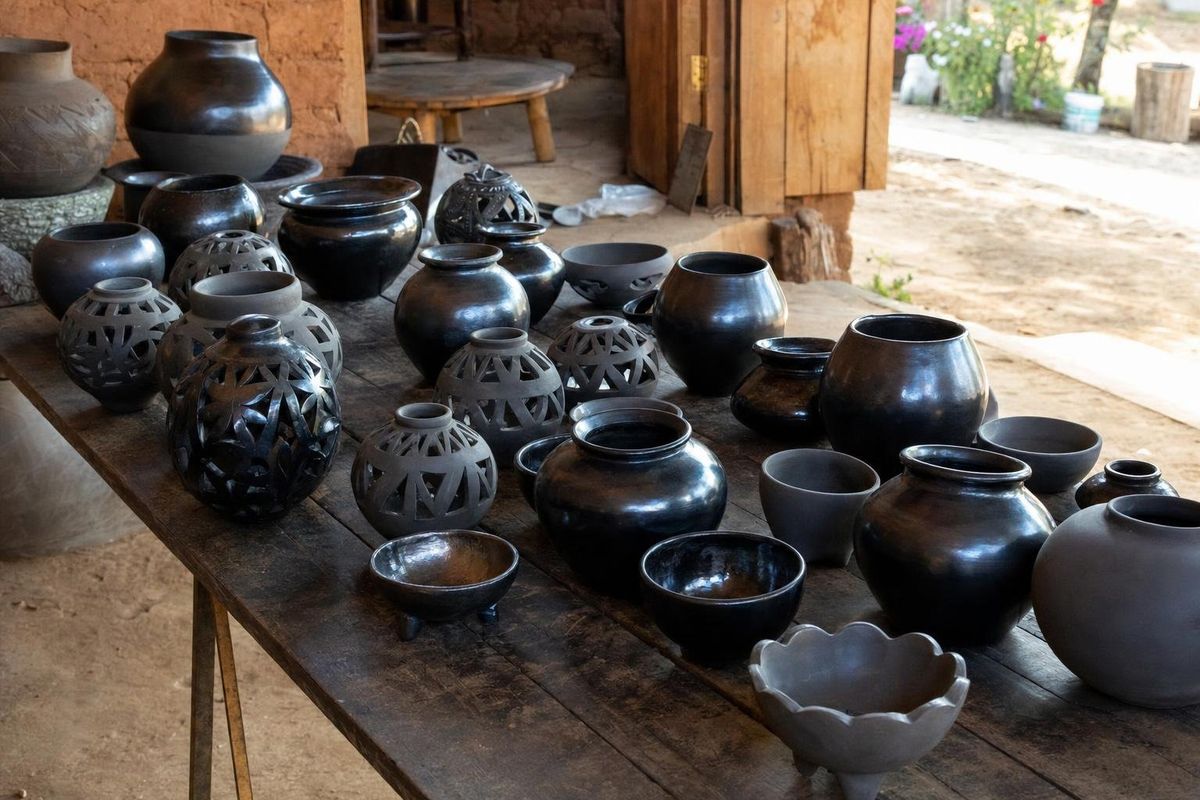
Much Zapotec art in Oaxaca today is made in villages rather than studios, and the line between art and craft is drawn differently than in a gallery. In San Martín Tilcajete, carvers paint copal-wood animals with dense patterns that often borrow the frets and diamonds of the ruins. In San Bartolo Coyotepec, potters cut stepped-fret openwork into black clay lanterns. In Teotitlán del Valle, the same motifs are woven into wool. Each medium changes the design: a fret carved in stone has hard edges, a woven one steps along the grid of the warp, a painted one bends around the body of an animal. Following one motif through three or four villages in a day is a good way to see how a shared visual language is kept alive by people who adapt it.
Zapotec rug paintings: when paintings become textiles
In the weaving village of Teotitlán del Valle, east of the city, weavers have long reproduced paintings in wool. Rugs copying well-known works of European modern art, as well as paintings by Oaxacan artists, became popular with buyers in the late twentieth century. Such pieces are sometimes called rug paintings. Alongside them, weavers create original compositions that rework Mitla frets, diamonds and animals in new combinations. The techniques behind both are explained on the page about Zapotec rug weaving.
Where to see Zapotec art
In Oaxaca city, the Museo de las Culturas de Oaxaca, in the former convent of Santo Domingo, holds archaeological finds including the treasure of Monte Albán's Tomb 7, as well as ethnographic collections. The city also has a museum of pre-Hispanic art with a large collection of ceramic figures and urns, a contemporary art museum in a colonial house on the main pedestrian street, and the Instituto de Artes Gráficas de Oaxaca, a graphic arts institute with exhibitions and a library.
Outside the city, Teotitlán del Valle has a small community museum, and the site museums at Monte Albán and Mitla show original carvings. Opening days change; check locally.
Buying respectfully
Buying from the workshop or studio that made a piece is the most direct way to support the artist. Galleries in the city center sell established names; small print workshops often sell editions at the press. A few points help:
- Signed and numbered prints should come with the edition number written by hand in pencil.
- Ask what a design represents. Many artists are glad to explain their sources, and the answer often says more than any label.
- Photographing work in a studio, and anyone in it, needs permission first.
Other crafts and the communities behind them are collected in the People of Mexico section.
Zapotec art: questions
What is Zapotec art known for?
Carved stones and funerary urns from Monte Albán, the stone mosaic frets of Mitla, and today painting, printmaking, wool rugs and wood carving in Oaxaca.
What do Zapotec designs mean?
Meanings are often interpretations. The stepped fret is commonly linked to lightning or the heavens, the diamond to an eye or the four directions, but readings differ.
What are Zapotec rug paintings?
Wool rugs woven in Teotitlán del Valle that reproduce or reinterpret paintings, from modern European masters to Oaxacan artists.
Where is ancient Zapotec art on display in Oaxaca?
At Monte Albán and Mitla and in the Museo de las Culturas de Oaxaca in the former convent of Santo Domingo.
Is Zapotec still spoken?
Yes. Zapotec is a group of related Otomanguean languages spoken by several hundred thousand people, mainly in Oaxaca.
Nearby on the map
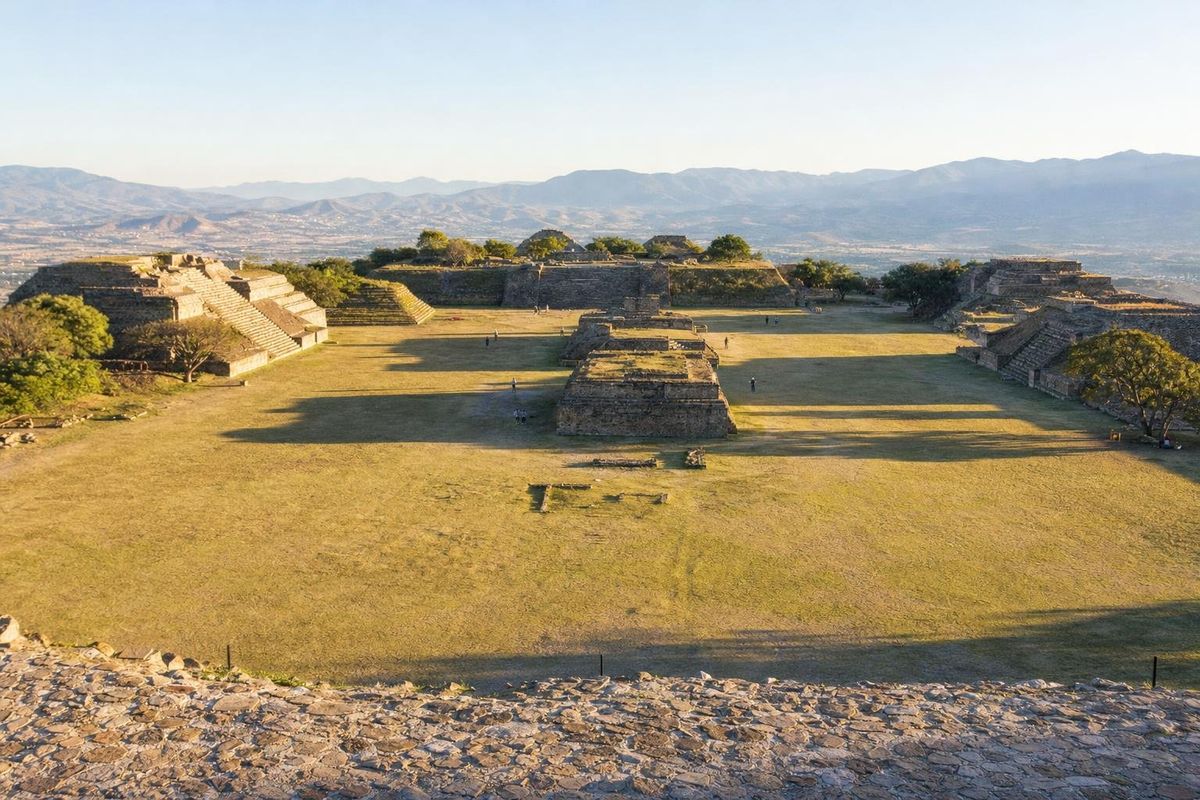
AI-generated image Maya Ruins · Oaxaca
Monte Albán
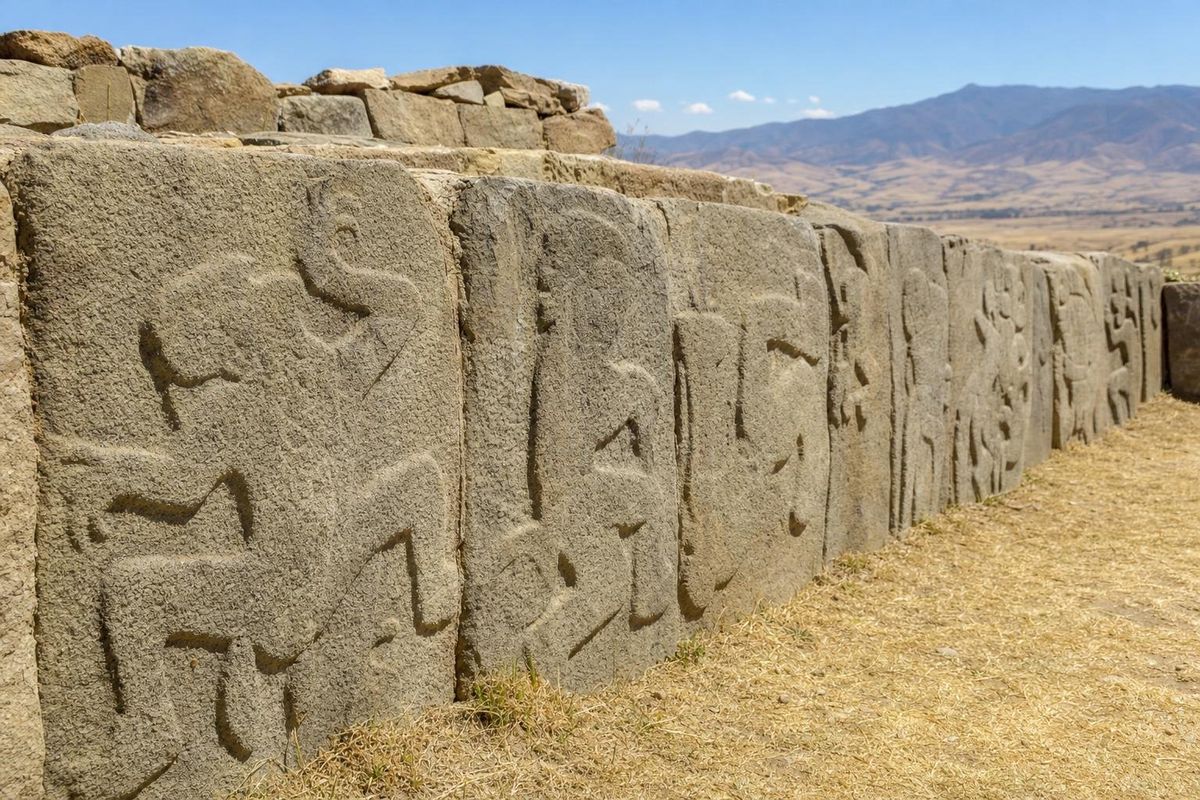
AI-generated image Maya Mysteries · Oaxaca
Zapotec Danzantes
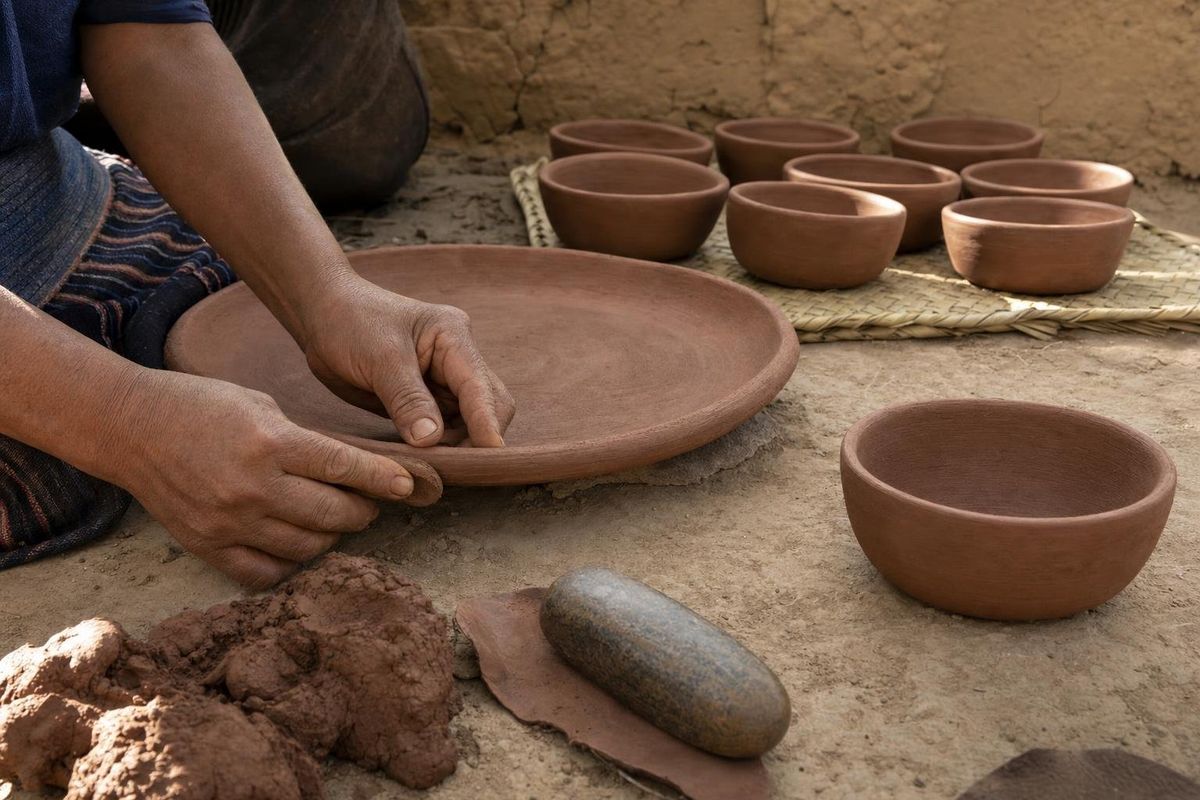
AI-generated image People of Mexico · Oaxaca
Zapotec pottery
AI-generated image Towns & Villages · Oaxaca
San Bartolo Coyotepec