
−45 m · Xibalba · Maya Mysteries · Tabasco
The Were-Jaguar and the Olmec Acrobats: Shamans and Twisting Bodies
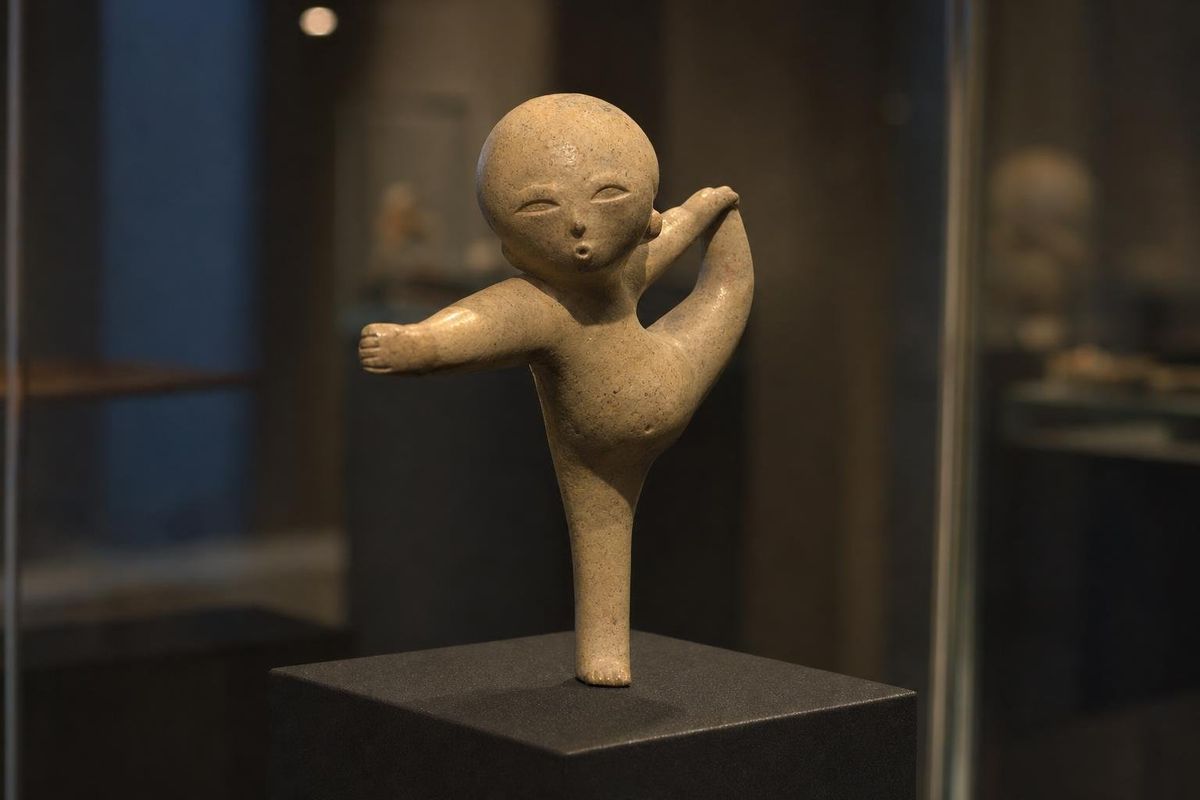
The were-jaguar is the strangest face in Olmec art: a plump, baby-like figure with a snarling, downturned jaguar mouth and a cleft in the top of the head. Alongside it, the Olmec world and its neighbours produced figures of acrobats and contortionists, most famously a clay acrobat from Tlatilco. Many scholars connect both to the idea of transformation, of shamans or rulers changing into animals or spirits.
The Olmec and their art
The Olmec culture flourished on the Gulf Coast of Mexico, in what are now southern Veracruz and western Tabasco, from about 1200 to 400 BC. Its main centres were San Lorenzo and, later, La Venta. The Olmecs are known for colossal stone heads, jade carving and a set of symbols that spread far beyond their homeland, into the highlands of central Mexico, Oaxaca and Guerrero. Whether that spread came from trade, prestige or something closer to religious influence is still discussed.
Much Olmec art is about bodies that are not quite human. Faces mix human and animal features; figures crouch, kneel, twist or hold infants. Without writing to explain them, every reading depends on comparison, with later Mesoamerican religion and with ethnographic accounts of shamans in the Americas.
What is a were-jaguar?
The term, coined by early archaeologists, describes a recurring face: almond-shaped eyes, a flat nose, a thick upper lip drawn into a trapezoid, toothless gums or small fangs, and often a V-shaped cleft at the top of the head. The bodies are frequently those of infants, chubby and sexless. Many are carved in jade or serpentine; others appear in the arms of adults on large stone monuments.
Readings of the were-jaguar
- A jaguar ancestor. Matthew Stirling, who excavated Olmec sites in the 1930s and 1940s, suggested that some monuments showed a union between a jaguar and a woman, producing a were-jaguar race. Few scholars accept this now.
- A family of gods. In 1971 Peter David Joralemon proposed sorting Olmec supernatural images into numbered gods, several with were-jaguar features. Later researchers, including Karl Taube, linked many were-jaguar infants to rain and to maize, identifying the cleft head with sprouting corn.
- Shamanic transformation. Peter Furst argued in the late 1960s that were-jaguar imagery shows shamans turning into jaguars, as shamans in many Amerindian traditions are said to do. F. Kent Reilly developed the idea, describing a set of carved figures as transformation figures.
The readings are not exclusive. A ruler might claim the powers of a shaman, communicate with rain and maize deities, and present himself with jaguar traits all at once.
Transformation figures and the Las Limas sculpture
Several small stone figures show a kneeling or standing man whose face and body are halfway between human and jaguar. Some museums, including Dumbarton Oaks in Washington, hold examples. Reilly arranged such pieces in sequence, from a fully human man in a kneeling pose to one with jaguar features, as stages of a single process of change. The sequence is a modern arrangement, but the figures themselves show clear mixing of human and animal traits.
The Las Limas figure, a greenstone sculpture found by villagers in Veracruz in 1965, shows a seated youth holding a limp were-jaguar infant across his lap. His shoulders and knees are incised with profiles of supernatural beings, which Joralemon and others used as a key to the Olmec pantheon. It is now in the Museum of Anthropology in Xalapa.
The acrobats
The best-known acrobat in ancient Mexican art comes from Tlatilco, a village site on the western edge of the Valley of Mexico with strong Olmec-style connections. Found in a burial, the ceramic figure lies on its stomach with its back arched so far that the feet rest beside the head. It dates to roughly 1200 to 900 BC and is on display in the National Museum of Anthropology in Mexico City.
Smaller carved stone figures of contortionists are also known from the Olmec world, some with were-jaguar features. Why make such images? Interpretations include:
- Shamans in an extreme posture used to reach an altered state, part of the transformation idea above.
- Performers at rituals or feasts, celebrated for real physical skill.
- Symbolic images of a body bent into a circle, perhaps linked to ideas of the cosmos or rebirth.
Physical skill was clearly valued. Ballplayers, dancers and acrobats appear across Mesoamerican art for the next two thousand years, and the ballplayers have their own page.
| Object | Where found | Where to see it |
|---|---|---|
| Tlatilco acrobat | Tlatilco, State of Mexico | National Museum of Anthropology, Mexico City |
| Las Limas figure | Las Limas, Veracruz | Museum of Anthropology, Xalapa |
| La Venta monuments | La Venta, Tabasco | Parque-Museo La Venta, Villahermosa |
A living tradition of ritual acrobatics
One acrobatic ritual from the Gulf Coast still survives. In the ceremony of the voladores, associated above all with the Totonac people of Veracruz, four men tied by the waist to ropes wound around a tall pole descend head down as the ropes unwind, while a fifth plays flute and drum at the top. Since 2009 UNESCO has listed it as intangible cultural heritage of humanity. Its origins are much later than the Olmecs, and no direct line connects the two, but it shows how performance and religion could meet in the same body.
Seeing the were-jaguar in person
Three museums cover most of the subject. The National Museum of Anthropology in Mexico City has the Tlatilco acrobat and a strong Olmec hall, an easy addition to the Mexico City trips. The Museum of Anthropology in Xalapa, Veracruz, has the Las Limas figure and monuments from San Lorenzo. The Parque-Museo La Venta in Villahermosa displays the La Venta sculptures outdoors among trees. The Veracruz coast also has the later Totonac site of Cempoala. More recurring figures are collected under Maya Mysteries.
In the Olmec hall, walk around the small jade pieces rather than viewing them only from the front. The cleft head and the profile of the mouth often read best from the side.
Questions about the were-jaguar and Olmec acrobats
What is an Olmec were-jaguar?
A recurring figure in Olmec art with a baby-like body, a snarling jaguar-like mouth and often a cleft head. It is usually read as a supernatural being linked to rain, maize or shamanic transformation.
Were Olmec shamans real?
There are no Olmec texts describing religious specialists. The shaman reading comes from comparing the art with later Mesoamerican and wider Amerindian practices, and it remains an interpretation.
Where is the Tlatilco acrobat?
In the National Museum of Anthropology in Mexico City. The ceramic figure shows a person lying on the stomach with the back arched and the feet beside the head.
Why does the were-jaguar have a cleft head?
Scholars disagree. Some link the cleft to sprouting maize, others to a physical feature of jaguars or to a symbolic opening to the spirit world.
Are the Papantla flyers connected to the Olmecs?
Not directly. The voladores ceremony is far later and belongs to the Totonac and neighbouring peoples, but it is a surviving example of acrobatic ritual from the same coast.
Nearby on the map
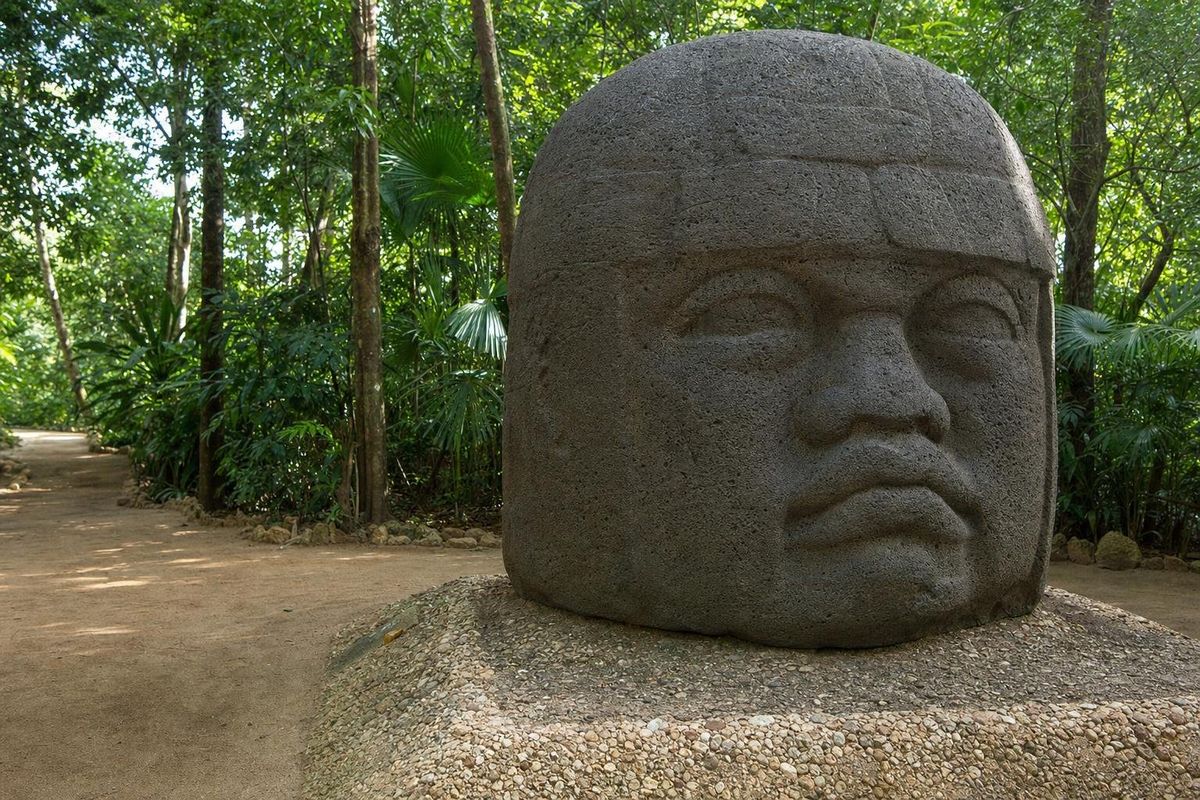
AI-generated image Museums · Tabasco
La Venta
AI-generated image Lakes & Rivers · Chiapas
Sumidero Canyon
AI-generated image Towns & Villages · Chiapas
Chiapa de Corzo
AI-generated image Towns & Villages · Chiapas
Zinacantán