−5 m · Shallows · Haciendas · Yucatán
Hacienda San Pedro Ochil: a Restored Henequén Estate near Uxmal
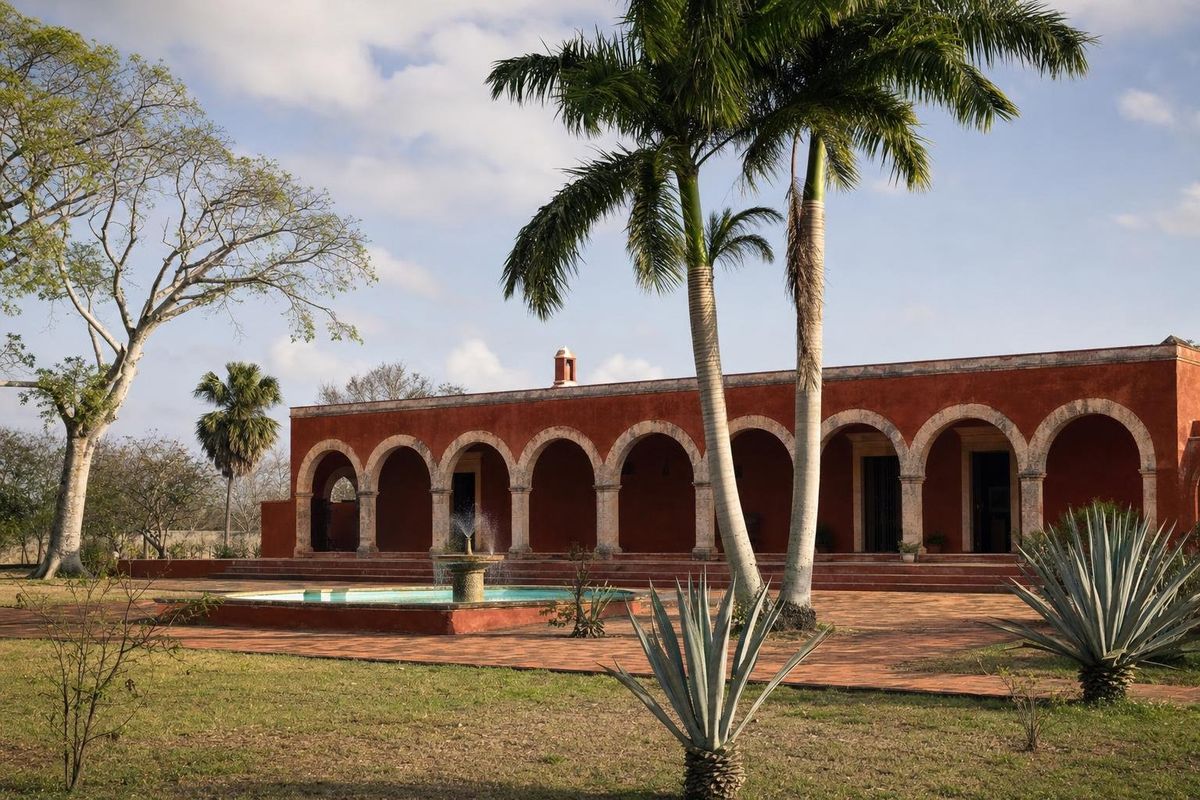
Hacienda Ochil, formally San Pedro Ochil, is a restored henequén estate in the municipality of Abalá, just off the highway from Mérida to Uxmal, roughly 45 kilometers south of the city. It works today as a small open-air museum of the henequén era, with craft workshops, a restaurant, a cave cenote and long shady gardens, and it is one of the easiest haciendas to visit on the way to or from the Puuc ruins.
From cattle ranch to henequén estate
Like many Yucatecan haciendas, Ochil began as a colonial cattle ranch. In the seventeenth century the land around it was granted to Spanish settlers, and for two centuries it raised cattle and maize with a small workforce. Everything changed in the nineteenth century, when the world began to buy henequén.
Henequén is an agave whose long, tough leaves yield a fiber ideal for rope and twine. From about the 1870s, demand from North American farmers, who needed binder twine for mechanical harvesters, set off a boom that made Yucatán one of the richest regions in Mexico. People called the fiber green gold. Ochil, like dozens of estates around Mérida, turned its land over to agave fields and built a machine house to scrape and dry the fiber.
The work was hard and the system harsher. Harvesting and carrying the leaves was done by hand in great heat. Maya workers lived on the estate in housing owned by the hacienda, were paid in tokens valid only in the hacienda shop, and were tied to the land by debts that passed from parents to children. The prosperity of the planters and the poverty of the workers were two sides of the same business.
A working hacienda was laid out like a small town. The main house faced a courtyard or terrace; nearby stood the machine house where the leaves were scraped, a chapel, the estate shop, offices, and the rows of workers' houses. Ochil keeps enough of that plan to make it readable, which is part of its value.
Decline and rescue
The boom did not last. Competition from other fibers and other producing countries, the disruption of the Mexican Revolution, and later the arrival of synthetic fibers undercut henequén through the twentieth century. In 1937 President Lázaro Cárdenas carried out a sweeping land reform in Yucatán that took most henequén land from the haciendas and handed it to communal farms called ejidos, leaving the old main houses and machine buildings stranded.
Many haciendas were abandoned, stripped and left to the forest. Ochil was among them. It was restored at the end of the twentieth century as part of a wider effort to bring old estates back to life together with the villages around them, using traditional materials. The deep red walls are finished with a lime-based treatment colored with local red earth, which gives them the soft, uneven patina typical of restored haciendas in the region.
What to see at Hacienda Ochil
The layout is easy to follow: a long main house with an arcade facing a terrace, outbuildings and a chapel around it, and gardens beyond.
The henequén museum
Part of the main house holds a small museum on the henequén process, with tools, photographs and explanations of how the leaves were cut, scraped, dried and baled. It is a good introduction before seeing ruined machine houses elsewhere in the state.
Rail tracks and machinery
Narrow-gauge rail tracks still run across the grounds. Mule-drawn platform carts on lines like these carried leaves from the fields to the machine house and bales on towards the railways and the ports of Progreso and Sisal. Old pieces of machinery and the chimney of the steam plant stand among the buildings.
Workshops and crafts
Artisans from nearby communities work on site in silver filigree, stone carving and henequén fiber, and their work is sold in a shop set in the former chapel. The quality is high, and prices reflect that.
The cenote and gardens
Below the main terrace, a cave cenote is set at the bottom of a stepped, amphitheater-like space used for events. It is a feature to look at rather than a swimming cenote. The gardens are the best part of a visit for many people: palms, flowering trees, a big ceiba, and rows of henequén planted as a reminder of what the estate grew. Near the ceiba, carved stones from an earlier Maya settlement on the site can be seen.
Getting there
Take Highway 261 south from Mérida towards Umán and Muna, the road to Uxmal. The hacienda is signposted off the highway in Abalá municipality, usually under an hour's drive from the city. Uxmal is roughly half an hour further south. There is no convenient public transport to the gate, so a car, a taxi or an organized tour is the practical choice.
Opening hours and whether an entry charge applies change, so check before going.
Combining Ochil with the Puuc Route
Most visitors stop at Ochil for lunch and a walk around the grounds before or after Uxmal. With an early start, a day can take in Uxmal and one of the smaller Puuc sites such as Sayil or Labná. With two days, add the Loltún caves or the older city of Oxkintok. The Puuc hills trip sets out the whole route, with Mérida as the base.
Ochil is often compared with Yaxcopoil, another henequén estate on the same highway, whose main house has a similar arcade and Moorish-style arched gateway. Yaxcopoil has been kept closer to its faded, unrestored state, which makes the two an instructive pair.
Practical notes
- Visit in the morning or late afternoon; midday heat is intense from March to May.
- Insect repellent helps in the gardens during the rainy season, roughly June to October.
- Do not climb on the old machinery or enter the cenote unless invited to.
- Cards are not always accepted, so carry some cash for the shop or restaurant.
Other estates open to visitors are listed under Haciendas.
Hacienda Ochil questions
Where is Hacienda Ochil?
In the municipality of Abalá, Yucatán, just off Highway 261 between Mérida and Uxmal, roughly 45 kilometers south of Mérida.
Can you swim in the cenote at Hacienda Ochil?
No. The cave cenote is a feature of the event space below the main terrace and is not used for swimming.
What is henequén?
An agave plant native to Yucatán whose leaves give a strong fiber used for rope and twine. Its boom from the late nineteenth century built most of the region's haciendas.
How long should a visit take?
About an hour to walk the museum, workshops and gardens, longer with lunch. Many people combine it with Uxmal the same day.
How does Ochil differ from Yaxcopoil?
Both are henequén estates on the Mérida to Uxmal highway with similar arcaded main houses. Ochil has been fully restored with gardens and workshops, while Yaxcopoil has been kept closer to its old, weathered state.