
−20 m · Stone · Maya Ruins · Chiapas
Bonampak Murals: Three Painted Rooms of a Maya Court in Chiapas
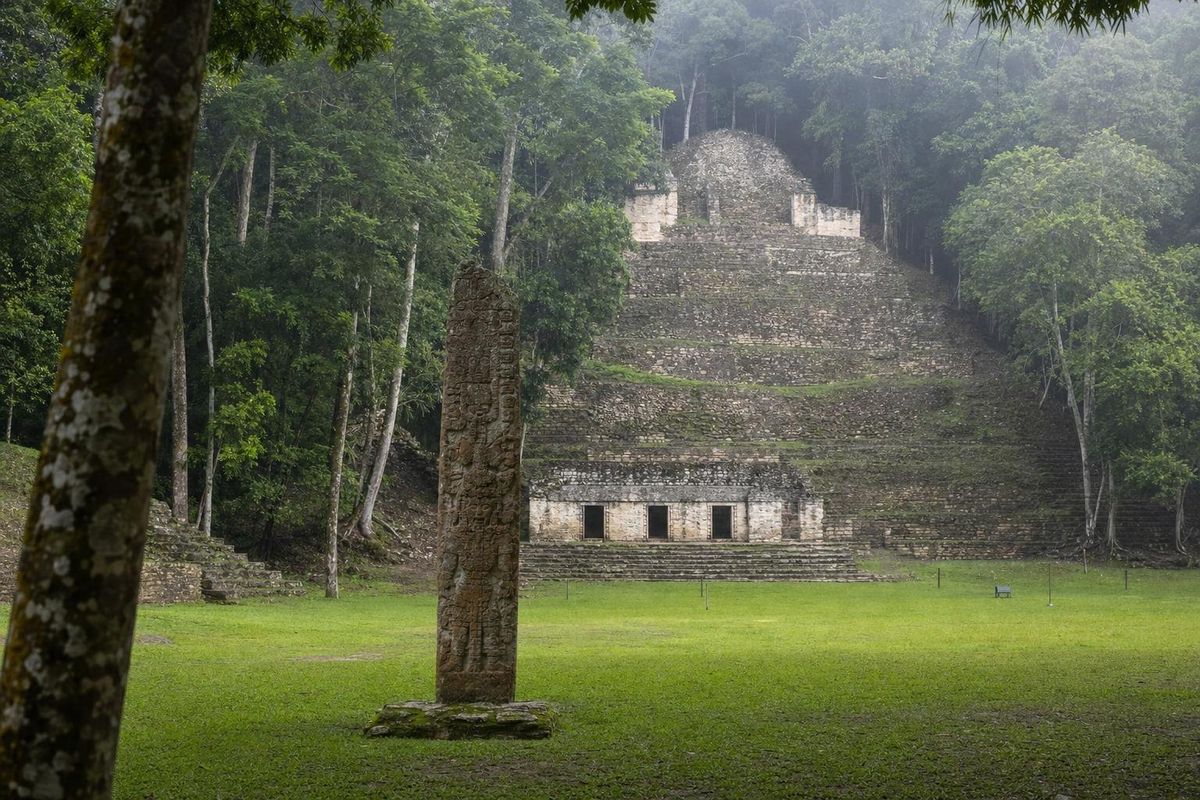
Bonampak is a small Maya site in the Lacandón forest of eastern Chiapas, roughly 150 km southeast of Palenque, and it is known for one building. The Bonampak murals cover the walls and vaults of three rooms in Structure 1 and show a royal court around AD 790: a ceremony for an heir, a battle, the treatment of captives and a celebration with dancers and bloodletting. Nothing else painted by the Classic Maya on a wall survives in such completeness.
A minor city with a famous temple
Bonampak was never a large capital. It sat in the orbit of bigger neighbors along the Usumacinta River, above all Yaxchilán, about 30 km to the north, and it spent much of its history trading, fighting and intermarrying with that city and with Piedras Negras across what is now the Guatemalan border. Inscriptions describe lords of Bonampak captured in wars of the fifth and sixth centuries, and by the later Classic period the town was a junior partner of Yaxchilán.
The ruler at the time the murals were painted, Yajaw Chan Muwan II, appears to have owed his position partly to that alliance. His wife came from the royal house of Yaxchilán, and Yaxchilán lords stand among the guests in the paintings. The murals were painted near the end of the city's building history, and some areas were never finished. Within a generation or two the city was abandoned, like most of the southern lowlands.
The name Bonampak is modern. Sylvanus Morley coined it from Yucatec Maya words usually translated as "painted walls". The inscriptions seem to call the place something else, and a reading often given is Usiij Witz, "Vulture Hill".
Outsiders reached the ruins in 1946, when Lacandón Maya men who knew the site led visitors to it. The American photographer Giles Healey was the first outsider to see the painted rooms.
The Bonampak murals room by room
Structure 1, often called the Temple of the Murals, stands at the foot of the acropolis on the south side of the plaza. It has three separate rooms, each entered through its own doorway, each small enough that only a couple of people fit inside at once. The figures are painted at around two thirds of life size, and many of them carry glyph captions with their names and titles. Mary Ellen Miller of Yale, who led a long documentation project with infrared photography, has argued that the three rooms should be read together as one program rather than as three separate pictures.
| Room | Main subject | What to look for |
|---|---|---|
| Room 1 (east) | Presentation of a royal child to the nobles; dressing of lords; a procession of musicians | Rattles, drums and long trumpets; masked dancers, one of them dressed as a crab; lords in white capes |
| Room 2 (center) | A battle in the forest, then the captives brought before the ruler | Chan Muwan in a jaguar tunic seizing an enemy by the hair; captives bleeding from the fingers on a stairway |
| Room 3 (west) | A celebration on the steps of a pyramid | Three dancers in tall quetzal-feather headdresses and wing-like costumes; royal women drawing blood from their tongues |
Room 1: an heir and a court
The upper register shows the court gathered while a small child is held up before the lords, a scene most scholars read as the presentation of an heir. On another wall servants dress three lords in jaguar pelts and feathered headdresses, adjusting bracelets and painting their bodies. Below runs a procession of musicians and masked performers.
Room 2: the battle and the captives
Room 2 holds the most famous image. Across three walls warriors with thrusting spears and shields clash in a dense melee, and at the center Chan Muwan grabs an opponent by the hair. On the north wall, the scene usually titled the presentation of captives to Lord Chan Muwan, the ruler stands on a terraced stair surrounded by his court while naked prisoners sit and kneel below him. Several are holding up hands that drip blood, a sign that their fingernails have been torn out. A severed head rests on a step. A visitor sitting on the bench inside the room would have had the captives at eye level.
The battle paintings did a lot to end an older idea that the Classic Maya were a peaceful people of astronomer-priests. One more recent proposal reads some of the captives as scribes, singled out because writing was a tool of royal power. That reading is debated. Miller has pointed out that the painted stair has the same number of steps as the real stair rising from the plaza to the stelae of the acropolis.
Room 3: the dance
The last room shows the aftermath. Three young lords, probably the same princes seen in Room 1, dance in towering green headdresses of quetzal feathers. Royal women seated on a throne pull cords through their tongues. Infrared images have revealed details that the eye no longer sees, including a dancer holding what appears to be a heart taken from a victim dragged down the steps.
The paint has suffered. In the years after the rediscovery, an attempt to brighten the colors with kerosene weakened the plaster, and much of what visitors see today is faded or flaked. The famous bright images in books are mostly reconstructions, several of them painted by the artist and archaeologist Heather Hurst for the Yale project.
Stelae, the acropolis and a tomb under the paintings
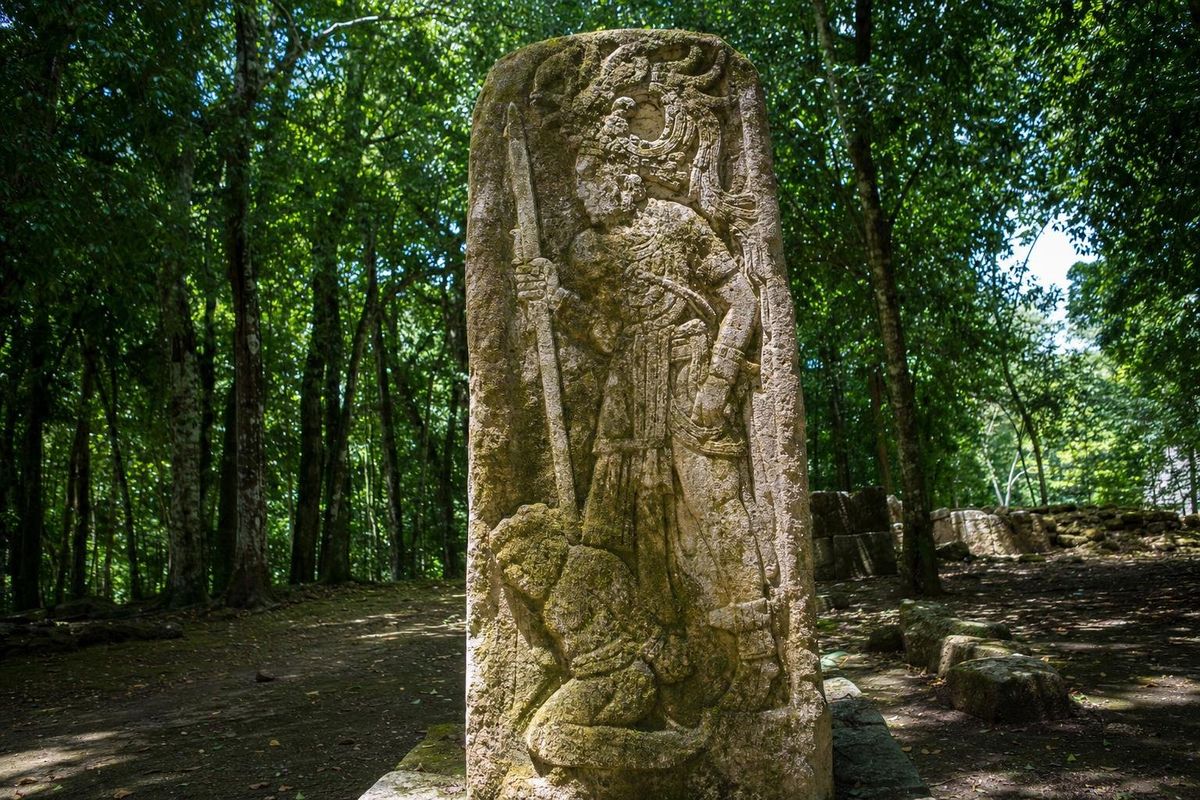
The plaza has its own highlights. Stela 1, close to 6 m tall, shows Chan Muwan with a ceremonial staff and is one of the tallest Maya stelae known. Up the acropolis steps, Stela 2 shows the ruler preparing for a bloodletting rite between two women, usually identified as his mother and his wife, and Stela 3 shows him standing over a kneeling captive.
Restoration work after earthquakes in the 2000s led to a discovery beneath Structure 1: a sealed burial of a man without his skull, wearing jade ear ornaments and a spiny-oyster shell pendant, with ceramic plates and a stone blade. Archaeologists have not settled who he was. Suggestions range from a sacrificed noble captive to a member of the Bonampak royal family whose death the murals were meant to commemorate.
Getting to Bonampak
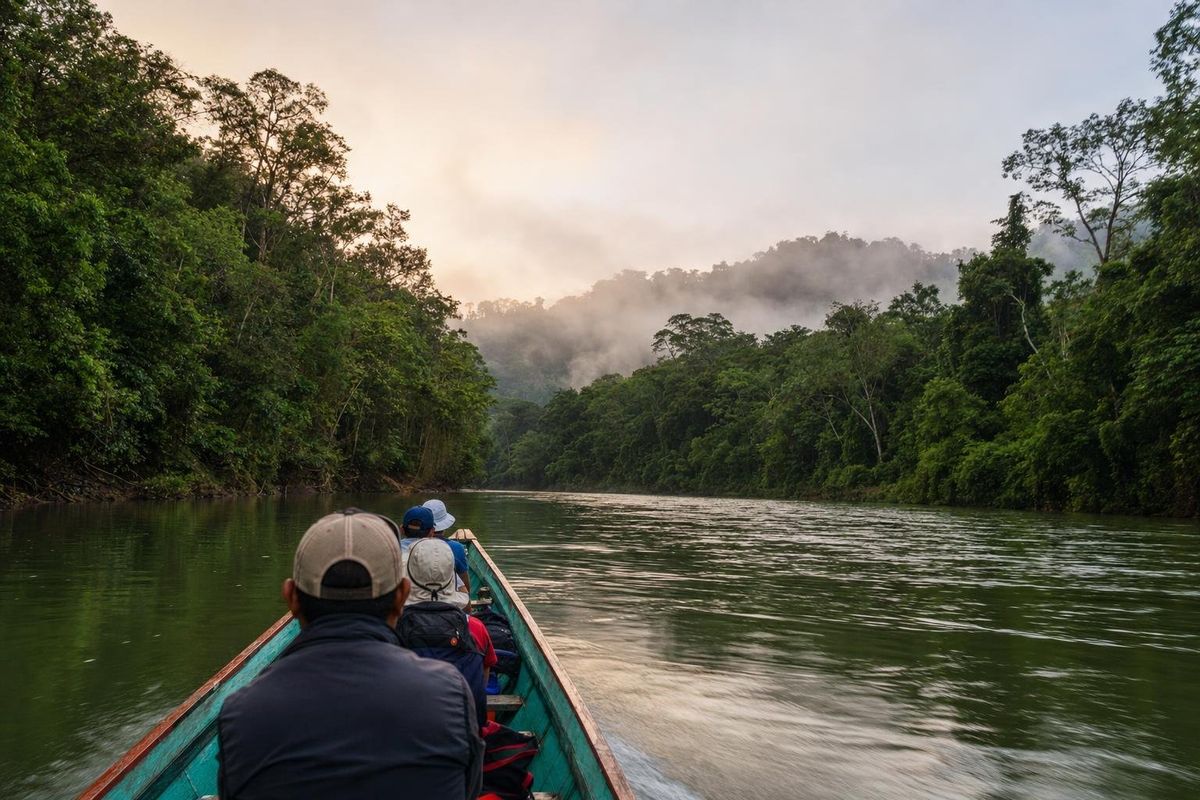
Bonampak lies off the Carretera Fronteriza, the road that runs along the Guatemalan border from Palenque. The drive from Palenque takes around three hours. Near the turnoff is the Lacandón community of Lacanjá Chansayab, and the last stretch through community land is usually covered in vehicles run by the local Lacandón cooperative rather than in private cars. Arrangements change, so confirm them locally before setting out.
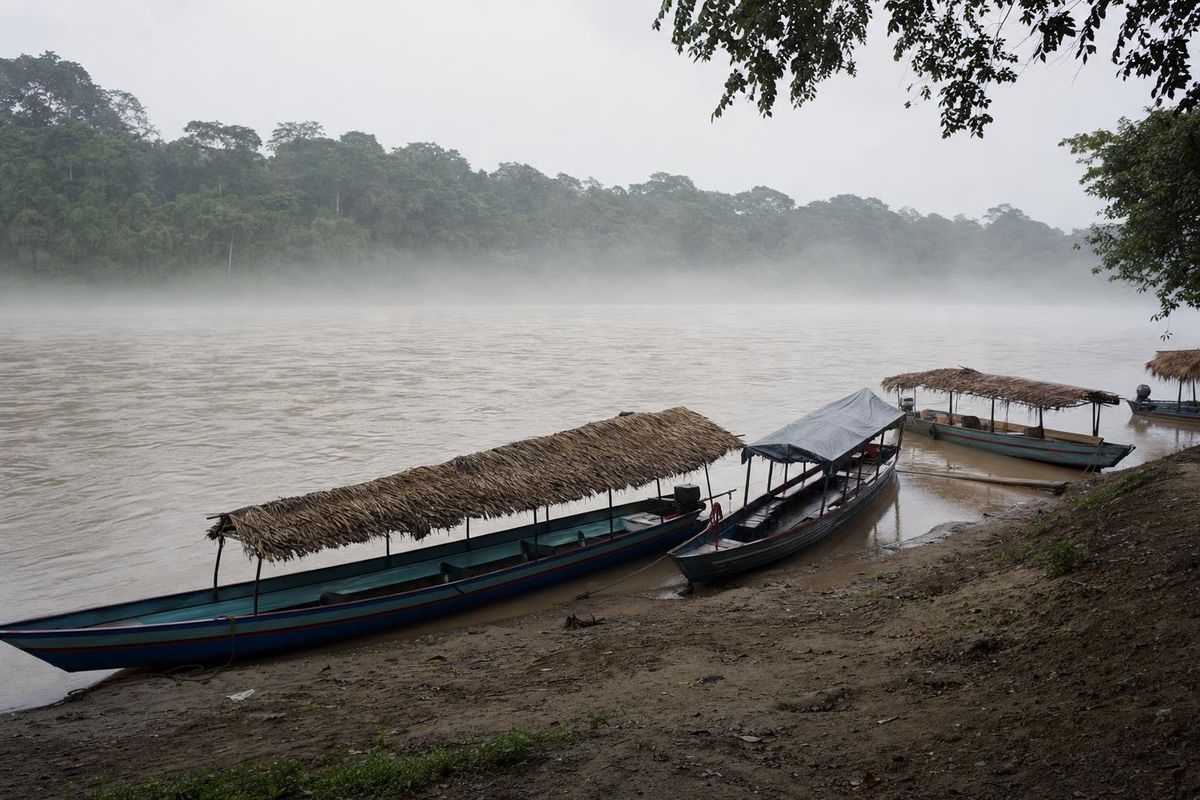
Most visitors pair Bonampak with Yaxchilán, reached by boat from Frontera Corozal about an hour further along the same road. Doing both as a day trip from Palenque is possible but long. Spending a night in the forest makes the visit calmer and lets you reach the murals before the day groups.
The Carretera Fronteriza has military and community checkpoints, so carry your passport, and drive it in daylight.
Practical notes for the painted rooms
- Flash photography is not allowed inside the rooms, and guards limit how many people enter at a time.
- The paintings are easier to read with a guide or with printed reconstructions in hand. Local Lacandón guides often carry diagrams of the walls.
- Bring insect repellent, water and something against rain at any time of year. The forest is humid, and the wet season runs roughly from June to October.
- Opening hours and fees change. Check them locally or with INAH, which manages the site.
If you cannot reach Chiapas, the Maya hall of the Museo Nacional de Antropología in Mexico City has a full-size copy of Structure 1 with the murals painted in their original colors. For more on how the Maya fought, see the page on Maya warriors, and for other sites in the region, the Maya ruins section. The crab-costumed dancer in Room 1 is easy to miss: look low on the wall, near the musicians.
Bonampak questions
What do the Bonampak murals show?
They show a Maya court around AD 790 in three rooms: the presentation of a royal child with musicians and dancers, a battle followed by the display of captives before the ruler, and a celebration with dancers and royal bloodletting.
What does the name Bonampak mean?
It is a modern name, coined in the 1940s from Yucatec Maya words usually translated as "painted walls". The ancient name in the inscriptions appears to have been different.
Can you see Bonampak and Yaxchilán in one day?
Yes, from Palenque or from a base along the Carretera Fronteriza, but it is a long day with several hours of driving and a boat ride. An overnight stay near the sites makes it easier.
Is photography allowed inside the mural rooms?
Photos without flash have generally been allowed, but rules can change, so ask at the entrance.
Where can you see a reconstruction of the murals?
The Museo Nacional de Antropología in Mexico City has a full-size copy of the temple with the murals painted in reconstructed colors.
Nearby on the map
AI-generated image Maya Mysteries · Chiapas
Warriors
AI-generated image Towns & Villages · Chiapas
Frontera Corozal
AI-generated image Trips · Chiapas
Eerie Legends
AI-generated image Maya Ruins · Chiapas
Yaxchilán