
−5 m · Shallows · Beaches · Quintana Roo
Tankah Bay North of Tulum: a Quiet Cove With Reef and Cenote
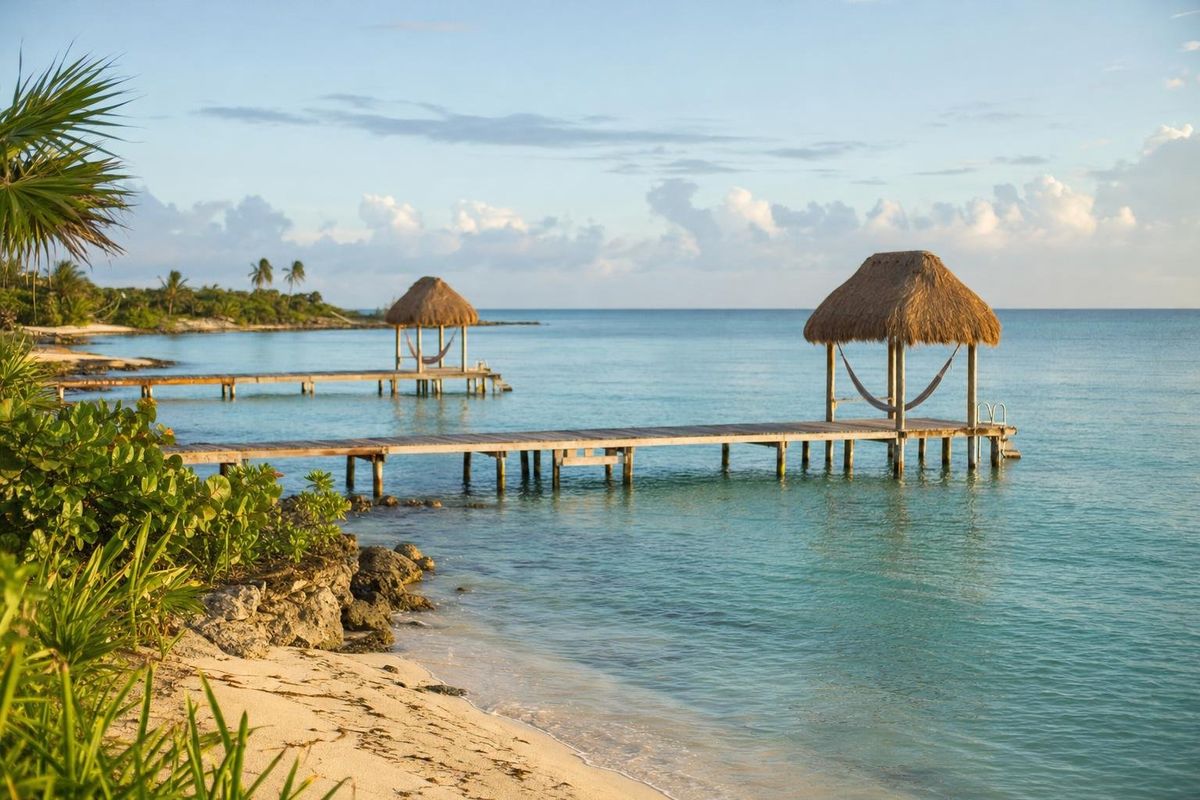
Tankah Bay is a quiet residential cove on the Riviera Maya, about eleven kilometers north of Tulum, sheltered by the reef and known for two wooden piers capped with palapa roofs. Behind the beach lies Casa Cenote, and the name Tankah links the bay to an ancient Maya town older than Tulum itself.
What Tankah Bay is like
Tankah Bay feels like the Riviera Maya before the boom. A dirt road runs behind a line of houses and small hotels, and the beach in front is often close to empty. Points of land separate it from Soliman Bay to the north and from Caleta Tankah to the south, so the bay has its own sheltered water.
The piers are the landmark. Each ends in a thatched shelter with hammocks slung underneath, a scene that turns up in a good many photographs of the coast without a name attached. The shore around them is a mix of sand, sea grass and rock, held in place by native chit palms and sea grape that protect the dunes from erosion.
It is not a powder-white resort beach. Sea grass lines the shallows, coral rubble collects at the tideline, and the sand is coarse in places. The trade-off is space and quiet.
Tankah and the Maya
Tankah is a Maya name, often glossed as something like "town center" or "dense settlement". It belongs to an ancient settlement, spelled Tancah in archaeological literature, that occupied this stretch of coast long before the walled city at Tulum rose a few kilometers south. Occupation at Tancah appears to go back to the last centuries BC, and the site was still in use in the Late Postclassic, when it and Tulum formed part of the same coastal network.
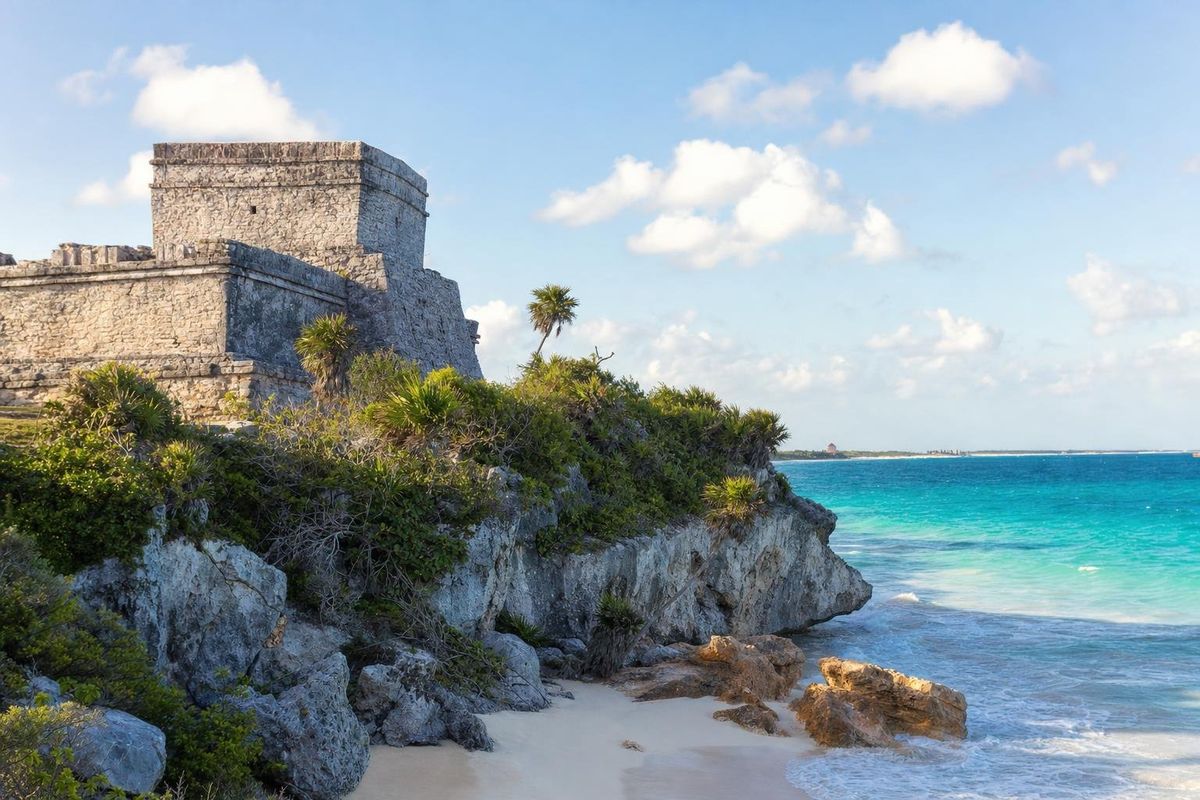
Tancah is best known to archaeologists for its painted murals, studied together with those of Tulum by Arthur G. Miller in his 1982 book On the Edge of the Sea. One theory holds that Tulum grew as a better-defended ceremonial center for a population that had long lived around Tancah. The remains lie in the forest near Caleta Tankah rather than on Tankah Bay, and they are not set up for visitors. The restored site at Tulum, and the ruins of Muyil further south, give a better sense of what the coast's towns looked like.
Snorkelling, kayaking and the Eye of the Sea
The bay is shallow and protected, which makes it good for kayaking and for snorkelling over patches of reef and sea grass. The reef beyond is said to have been recovering since Hurricane Dean struck the southern Yucatán coast in 2007.
Look for the Ojo del Mar, the Eye of the Sea. It is a spot where fresh water from the underground river system feeding Casa Cenote wells up into the bay. On a calm day the surface shimmers where the cooler, clearer fresh water meets the salt; on a windy day it is easy to miss. It lies roughly opposite the cenote, close to shore.
Water shoes help when wading over sea grass, coral rubble and rock.
Casa Cenote, just behind the dunes
A few steps inland, across the Tankah road, Casa Cenote is a long, open cenote fringed by mangroves. Its water is a layered mix: fresh water on top, salt water below, and the shimmering halocline between them that divers come to see. The cenote is connected underground to the sea, which is why the Ojo del Mar exists at all. Manatees were once seen in it, and it was formerly known as Cenote Manatí; sightings now are rare.
The contrast with the beach is striking. The cenote is often busy with snorkellers, kayakers and dive groups while the bay a few meters away stays nearly empty. A fee is usually charged for the cenote. Rinse off sunscreen and insect repellent before entering any cenote.
How to find Tankah Bay
Tankah Bay is off Highway 307 about eleven kilometers north of Tulum, between Caleta Tankah to the south and Soliman Bay to the north. Its entrance is easy to confuse with Caleta Tankah, which is the better-signed turn about four kilometers closer to Tulum and leads to a private beach club with its own small cenote. The Tankah Bay turning is signposted with the names of hotels and restaurants rather than the bay itself.
From the highway, a dirt road crosses the mangroves past a security post and then runs along the line of houses behind the beach. Coming from Playa del Carmen, you may need to pass the turn and return. Colectivos stop at the highway on request, and the walk in is short.
Unlike Caleta Tankah, Tankah Bay has generally been free to visit, since the beach is public and the road is a residential access. Be prepared for that to vary.
When to go
December to April brings the driest weather and clearest water. Spring is warmer, and sargassum can arrive in quantity between about April and October in heavy years. Hurricane season runs from June to November, peaking in late summer.
The chit palms and sea grape along the bay give some shade, but bring your own for a full day.
Practical notes
- There are few facilities on the beach itself; the cenote and the small restaurants along the road have bathrooms.
- Bring your own snorkel gear unless you plan to rent at the cenote.
- Large conch shells sometimes wash up near the treeline. Leave live animals where they are.
- This is a residential bay. Keep noise down and do not use private piers or terraces.
The coast between Tulum and Akumal holds several similar coves; Cenote Caleta Tankah is the next stop south, and more are listed in the beaches section. INAH maintains information on the protected archaeological sites of Quintana Roo on its official website.
In the early morning, the hammocks under the pier palapas swing empty in the breeze.
Tankah Bay: questions travellers ask
Where is Tankah Bay?
On the Riviera Maya, off Highway 307 about eleven kilometers north of Tulum, between Soliman Bay and Caleta Tankah.
Is Tankah Bay the same as Caleta Tankah?
No. Caleta Tankah is the next bay south, a private beach club with its own cenote and an entry fee. Tankah Bay is a public beach reached by a residential road.
Are there Maya ruins at Tankah Bay?
The ancient settlement of Tancah lies in the forest near Caleta Tankah, not on the bay, and is not set up for visitors. Tulum's restored ruins are a short drive south.
What is the Ojo del Mar at Tankah?
A spot in the bay where fresh water from the underground river feeding Casa Cenote rises into the sea, creating a visible shimmer on calm days.
Can you snorkel at Tankah Bay?
Yes. The bay is shallow and sheltered, with sea grass and patch reef close to shore. Water shoes help on the rocky stretches.
Nearby on the map
AI-generated image Beaches · Quintana Roo
Soliman Bay
AI-generated image Cenotes · Quintana Roo
Caleta Tankah
AI-generated image Cenotes · Quintana Roo
Casa Cenote
AI-generated image Maya Ruins · Quintana Roo
Tulum Ruins