
−20 m · Stone · Maya Ruins · Quintana Roo
Cozumel Ruins: San Gervasio and the Island Shrines of Ix Chel
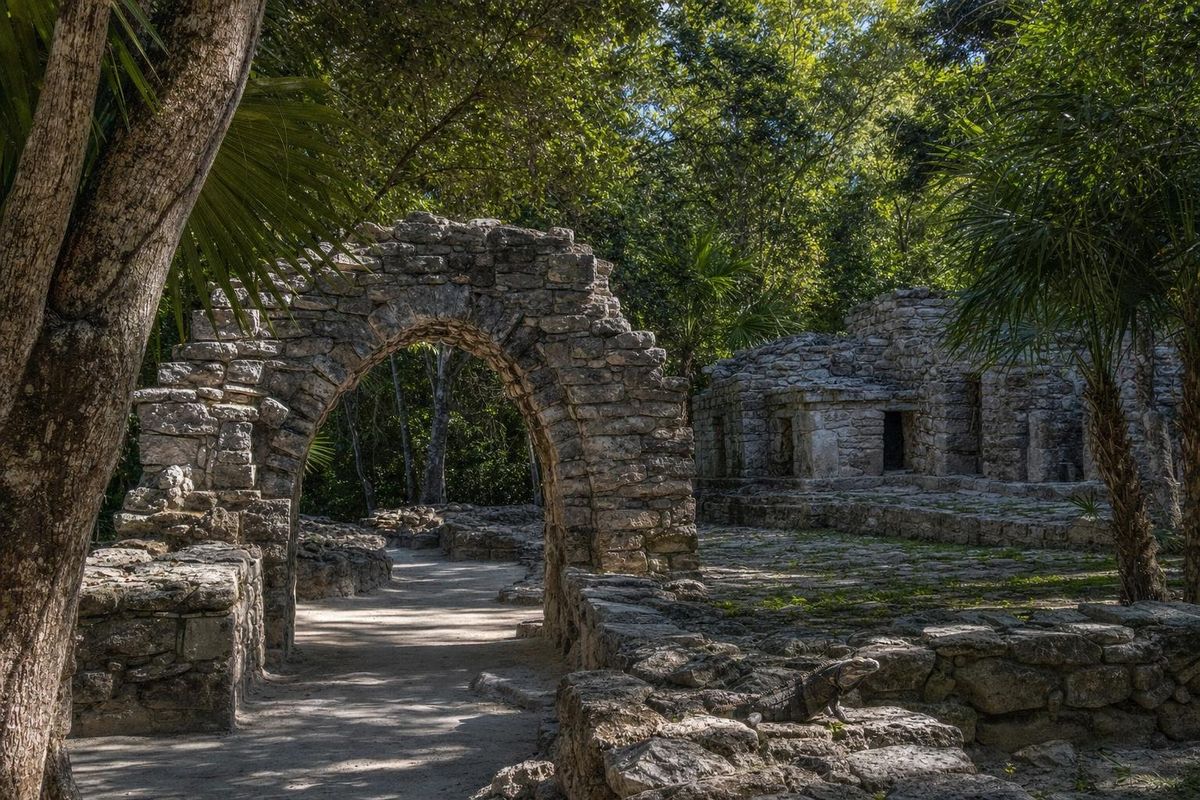
The Cozumel ruins are the remains of a Maya island that was one of the great pilgrimage destinations of the Yucatán peninsula. San Gervasio, in the forest of the island's interior, was its main ceremonial center and the home of a shrine to Ix Chel, the goddess of the moon, childbirth and weaving. The buildings are small rather than monumental, but the story behind them makes Cozumel one of the most interesting Maya places on the Caribbean coast.
Cuzamil, the island of swallows
The Maya called the island Cuzamil, usually translated as "place of the swallows". People settled here during the first millennium AD, and Cozumel grew into a significant center in the Postclassic period, especially from about 1200 to the Spanish conquest. Archaeologists have recorded over 30 ancient sites across the island, from towns to small shrines and lookout posts on the eastern shore, linked by raised white roads, the sacbeob.
Two things made Cuzamil important. The first was trade: the island lay on the canoe route that carried goods around the peninsula from the Gulf coast to Honduras, and its ports handled salt, honey, cloth and much more. The second was religion. Women from across the Maya region crossed the channel from mainland ports such as Xaman Há and P'olé to pray to Ix Chel for children and safe births. Colonial sources describe an oracle on the island, a statue through which priests are said to have spoken.
The Spanish arrived early. Juan de Grijalva landed in 1518, and Hernán Cortés stopped here in 1519 on his way to Veracruz, where his men toppled images in the shrines and set up a cross. Smallpox and conquest emptied the island over the following century. Cozumel was resettled in 1848 by families fleeing the Caste War on the mainland, and for a century it lived from fishing and chicle until diving and cruise tourism took over in the second half of the twentieth century.
San Gervasio: what to see
San Gervasio takes its name from a nineteenth-century ranch. It lies in the north-center of the island, reached by a side road off the cross-island highway. The site is spread over a wide area of forest, and only part of it is open. Paths link several groups of buildings, and some follow the old sacbeob.
Las Manitas
Near the entrance stands Las Manitas, "the little hands", named after red handprints on its interior walls. It is thought to have been the residence of a ruler in the Terminal Classic or Early Postclassic, with an outer room for living and an inner shrine. Red handprints in Maya buildings are often read as signs of life or dedication, but who left these is unknown.
The Central Plaza
The heart of the site is a plaza ringed by six buildings: temples, a colonnaded hall, a structure with small niches in its stairway, and buildings that may have housed visitors during festivals. They date mostly from the Late Postclassic and once had thatched or beam-and-mortar roofs. Several still show traces of plaster and paint.
Ka'na Nah and the arch
Ka'na Nah, "tall house", is the tallest building at San Gervasio, a stepped platform with a small temple on top, and many researchers link it to the cult of Ix Chel. A short walk away, a small corbelled arch spans the path where several sacbeob meet. It is the image of San Gervasio that appears most often in photographs.
The Cozumel pyramids
Visitors who expect tall pyramids like those of Chichén Itzá or Calakmul may be surprised. The buildings on Cozumel are low, in the East Coast style also seen at Tulum: small temples on platforms, narrow doorways, thick plaster and paint. Their importance lay in what happened in them, not in their size.
Other Cozumel ruins: El Cedral and El Caracol
El Cedral, in the south of the island, has a small Maya temple standing in the middle of a modern village, next to a church. It is the setting of an annual fiesta held in early May, which traces its origins to the families who resettled the island in the nineteenth century.
El Caracol stands near the southern tip of the island, inside the Punta Sur ecological park. It is a small, round-topped building with conch shells set into its upper parts. One widely repeated theory holds that the wind passing through it made a whistling sound that warned canoes of storms; others see it as a navigation marker. It is one of the most photographed Maya buildings on the coast.
The Museo de la Isla de Cozumel, on the waterfront in San Miguel, displays finds from the island's sites, sculptures, models and a reconstruction of a traditional Maya house, and is a good introduction before going to San Gervasio.
Getting to San Gervasio
Passenger ferries cross from Playa del Carmen to San Miguel, the island's only town, in under an hour. Schedules and operators change, so check them on the day. Car ferries run from a port south of Playa del Carmen.
From San Miguel, San Gervasio is roughly a 20-minute drive inland: follow the cross-island road east and turn north at the sign. There is no public transport to the site, so rent a car, scooter or bike, or take a taxi and agree on waiting time in advance.
Practical notes
- Go early. Cruise-ship excursions often arrive mid-morning, and the forest is cooler before then.
- Bring insect repellent, water and a hat. Paths are flat and easy.
- Iguanas, coatis and birds are common. Do not feed them. Cozumel has endemic species, including a small raccoon and the Cozumel emerald hummingbird.
- Signs at the site are in Spanish, English and Maya.
- Opening hours and fees change; check locally or with INAH.
For more on the figure carved upside down over doors along this coast, see the Descending God, and for other sites, the Maya ruins section. On the walk between the groups, watch the edges of the sacbeob: the white roads are still raised above the forest floor in places, edged with larger stones.
Cozumel ruins questions
What are the main Maya ruins on Cozumel?
San Gervasio, in the island's interior, is the largest and best preserved. El Cedral in the south and El Caracol in Punta Sur park are smaller sites.
Why did Maya pilgrims go to Cozumel?
To visit the shrine of Ix Chel, goddess of the moon, childbirth, medicine and weaving. Women in particular crossed from the mainland to pray for children and safe births.
Are there pyramids on Cozumel?
Not large ones. The island's buildings are small temples and platforms in the East Coast style; the tallest at San Gervasio is Ka'na Nah.
How do you get to San Gervasio from the ferry?
Drive or take a taxi from San Miguel along the cross-island road and turn north at the sign. The trip takes around 20 minutes.
How long do you need at San Gervasio?
About one to two hours is enough to walk the main groups at an easy pace.
Nearby on the map
AI-generated image Beaches · Quintana Roo
Xcalacoco
AI-generated image Beaches · Quintana Roo
Grand Coral
AI-generated image Beaches · Quintana Roo
Punta Esmeralda
AI-generated image Museums · Quintana Roo
Frida Kahlo Museum