
0 m · Surface · People of Mexico · Oaxaca
Zapotec Rugs and Carpet Weaving in Teotitlán del Valle: Wool and Dyes
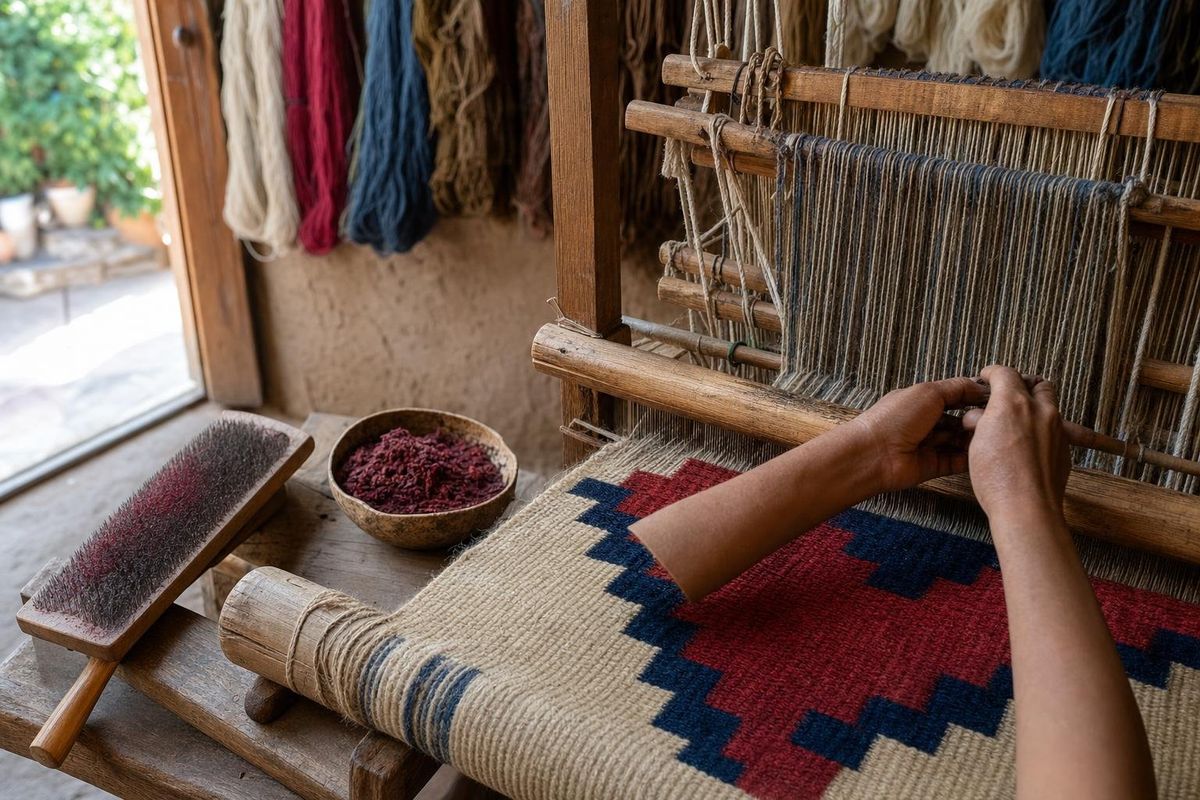
Teotitlán del Valle, about 30 km east of Oaxaca city at the foot of the Sierra Juárez, is the center of Zapotec rug weaving. Most households in the village spin, dye or weave wool on treadle looms, and many open their patios to visitors to show the whole process from raw fleece to finished rug.
A weaving village with deep roots
Weaving in the Oaxaca Valley predates the Spanish by many centuries. Before the conquest, cloth was woven on backstrap looms from cotton and other plant fibers, and Teotitlán is often described as a weaving town of long standing. The Spanish introduced sheep and the upright treadle loom in the sixteenth century, and wool weaving on that loom became the village's specialty. For a long time the main products were blankets and serapes for local and regional markets.
The shift toward rugs for foreign buyers came in the second half of the twentieth century, as road travel to Oaxaca grew and visitors began asking for floor and wall pieces. Today the village sells around the world, and neighboring Santa Ana del Valle and the larger town of Tlacolula have weavers too. Zapotec is still widely spoken in Teotitlán, and the craft is passed down within families.
From fleece to yarn
Good rugs start with good wool. Raw fleece, much of it bought from highland communities, is washed to remove grease and dirt, then carded between two wire brushes to align the fibers. The carded wool is spun into yarn on a large spinning wheel turned by hand. Hand-spun yarn has small irregularities in thickness that give a finished rug its slightly uneven, lively texture; machine-spun yarn is smoother and cheaper.
Some weavers leave part of their wool undyed, using the natural white, grey, brown and near-black of different sheep.
Natural dyes
Dyeing is where Teotitlán's reputation was made. Workshops that use natural dyes will usually demonstrate them, and the range of colors from a small set of sources is remarkable.
- Cochineal, a small scale insect that lives on nopal cactus, gives reds, pinks, oranges and purples. Dried and ground, the insects release a crimson dye; adding lime juice shifts it toward orange, and adding mineral salts shifts it toward purple. Cochineal was one of colonial Mexico's most valuable exports, and the Oaxaca region was a leading producer.
- Indigo produces blues from pale sky to near navy, built up by repeated dips.
- Plants such as pericón, a wild marigold, give yellows; nut husks, barks and other plants give browns and tans; lichens and mosses give soft greens and golds.
- Combinations, such as indigo over yellow for green, extend the palette.
Mordants, often alum, help the dye bind to the wool. Many weavers also use synthetic dyes, which are cheaper, faster and more color-fast in bright shades. There is nothing wrong with that, as long as a piece is sold for what it is.
On the treadle loom
The treadle loom is a heavy wooden frame with foot pedals that raise and lower alternate sets of warp threads. The warp, usually cotton or wool, runs lengthwise and stays hidden; the design is made entirely by the weft, the colored wool beaten down tightly between the warp threads. This weft-faced technique lets the weaver change color anywhere along a row, so complex geometric and pictorial designs are possible.
Most weavers work from memory or from a sketch placed under the warp. A rug of medium size can take several weeks, longer for fine wool, dense weaving or intricate designs. When it comes off the loom, the warp ends are knotted into a fringe.
Designs to look for
Classic Teotitlán designs draw on the stepped frets of the ruins at Mitla, the Zapotec diamond, zigzag lightning lines and stylized eyes and stars. Rugs reproducing paintings, a style explained on the page about Zapotec art, sit alongside them, as do modern abstract designs made for contemporary interiors. Women's cooperatives in the village have helped widen both the designs and the share of income that reaches women weavers.
Visiting Teotitlán del Valle
The village lies a few kilometers off Highway 190, the road to Tlacolula and Mitla. Colectivos run from Oaxaca city to the junction and into the village; the trip takes roughly 40 minutes. Many family workshops display a sign at the door, and visitors can walk in, watch carding, spinning and dyeing, and see rugs on the loom without any obligation. The village church, built in the colonial period on a pre-Hispanic platform, has carved Zapotec stones set into its walls, and the small community museum near the market explains local history and weaving.
A visit combines easily with the ruins of Mitla, the Sunday market in Tlacolula and the mezcal palenques of Santiago Matatlán farther along the same road.
Buying a rug well
- Feel the weave. A tight, dense weave lies flat, holds its shape and wears longer. Count the weft rows across a set width if comparing similar pieces.
- Check the edges and lines. Sides should be straight, corners square, and diagonal lines in the design smooth rather than jagged.
- Ask about the dyes. Workshops using natural dyes will name the sources for each color. Rubbing a damp white cloth over a color is a common test for loose dye.
- Buy at the source. Purchasing from the workshop that wove the rug puts the money with the weaving family. Rugs sold in city shops and abroad may come from the same village at several times the price.
- Carry or ship. Rugs fold well and travel easily in luggage; most workshops can also arrange shipping.
Photographs of people at work, or inside a home, should only be taken with permission. More crafts and their communities are collected in the People of Mexico section.
Zapotec rug weaving: questions
Where are Zapotec rugs made?
Mainly in Teotitlán del Valle, about 30 km east of Oaxaca city, and in nearby villages such as Santa Ana del Valle.
Which natural dyes do Zapotec weavers use?
Cochineal for reds, pinks and purples, indigo for blues, pericón and other plants for yellows, and barks, husks and mosses for browns and greens.
How long does it take to weave a rug?
A medium-size rug typically takes several weeks, depending on the density of the weave and the complexity of the design.
How do natural dyes differ from synthetic ones?
Ask the workshop to name the dye source for each color. Natural dyes tend to have softer, slightly varied tones, while synthetic dyes are more uniform and brighter.
Are weaving workshops open to visitors?
Yes. Many family workshops in Teotitlán del Valle welcome visitors to watch spinning, dyeing and weaving.
Nearby on the map

AI-generated image Maya Ruins · Oaxaca
Mitla
AI-generated image Towns & Villages · Oaxaca
San Bartolo Coyotepec
AI-generated image People of Mexico · Oaxaca
Zapotec art
AI-generated image Towns & Villages · Oaxaca
Matatlán