
−5 m · Shallows · Cenotes · Quintana Roo
Cenote Dos Ojos near Tulum: Snorkeling, Cavern Diving and Access
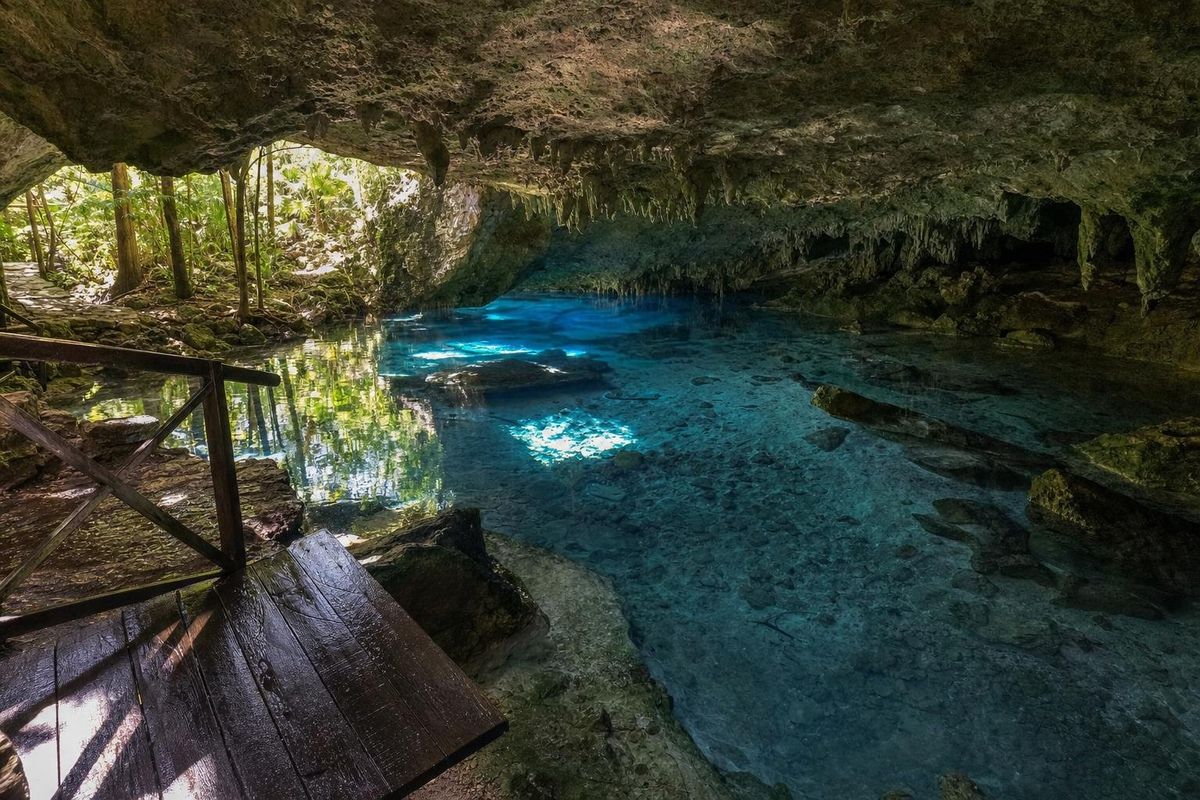
Cenote Dos Ojos lies in the forest about 20 km north of Tulum, a few kilometers inland from Highway 307. Its two cavern pools, the "two eyes" of the name, are entrances to the Sac Actun system, one of the longest underwater caves known anywhere, and the water inside is so clear that snorkelers seem to float above the rock. It is one of the most visited cenotes on the Caribbean coast, for divers above all.
What makes Dos Ojos different
Most cenotes on the coast are a single pool. Dos Ojos is two, joined underground. Each "eye" is a sinkhole where part of a cavern roof collapsed, leaving an opening to the forest on one side and a low ceiling of stalactites on the other. Between them runs a flooded passage roughly 400 meters long, the route divers follow from one pool to the other.
Behind those openings lies a vast system. Cave divers have spent decades mapping the tunnels around Dos Ojos, and in early 2018 explorers confirmed a connection with Sac Actun. The combined network now carries the Sac Actun name and runs to well over 300 kilometers of surveyed passage. One shaft in the Dos Ojos section, known as The Pit, drops beyond 100 meters and has long counted among the deepest known points in the cave systems of Quintana Roo.
The water is fresh at the surface and salty further down, where seawater pushes in from the coast. Where the two meet, divers see a shimmering, blurred layer called a halocline. Snorkelers stay well above it and see something simpler: pale limestone, columns where stalactites and stalagmites have grown together, roots hanging through cracks in the ceiling.
Snorkeling the two eyes
The East Eye is the smaller pool, reached by wooden decks and steps. Most of it is open water under the cavern roof, shallow enough in places to see every ripple on the floor, with darker passages leading off at the edges. The West Eye, a short walk further, is a wide ring of water around an island of forest, and snorkelers can follow it almost all the way round, moving from bright patches under the opening into shade under the ceiling and back again.
Snorkeling at Dos Ojos is mostly in water a few meters deep, with drops to around 10 meters in parts of the caverns. Visibility is the main event. On a sunny day, light enters at an angle and draws blue beams through the water, and the effect is strongest from late morning to early afternoon. Small fish dart along the walls and bats roost in the darker corners of the cave ceiling. Motmots, the birds with the racket-shaped tails, sometimes nest in the rock near the openings.
- Do not touch formations: a stalactite can take thousands of years to grow and breaks under a single fin kick.
- Stay out of passages beyond the daylight zone unless you are with a guide.
- Life jackets are commonly required for swimmers and snorkelers; follow the staff's rule on the day.
Cavern and cave diving
For divers, Dos Ojos is one of the best-known cavern sites in the world. A cavern dive stays within reach of natural light, follows a fixed guideline and needs only an open-water certification plus a qualified cavern guide. Two classic routes are known by nicknames: the Barbie Line, named after a doll placed in the jaws of a toy crocodile along the way, and the Bat Cave Line, which surfaces in an air pocket where bats hang from the ceiling.
Cave diving, beyond the reach of daylight, is a different discipline that requires full cave training and certification. Dives here are organized through dive centers in Tulum and Playa del Carmen; check credentials and group size before booking, and avoid anyone offering cavern dives without a guideline and a briefing.
Dos Ojos and the cenotes of the park
The land around Dos Ojos belongs to an ejido, a communally held property, and the community manages access to several cenotes on it. Nicte-Ha and others lie further along the same track and see fewer visitors. Facilities at the main entrance have generally included changing rooms, toilets, lockers, rental snorkel gear and picnic areas under the trees, though what is on offer changes and is worth checking locally.
Look out for the small stone shrines in the park built for the aluxes, the mischievous guardian spirits of Yucatec Maya folklore. Similar miniature houses stand in fields and gardens across the peninsula, and leaving them alone is a matter of good manners.
Getting to Cenote Dos Ojos
The turn-off is on Highway 307 between Tulum and Playa del Carmen, roughly 20 km north of Tulum and close to the entrance of Xel-Há. From the highway, an access road runs inland for a few kilometers to the cenote. Do not stop at the first booth near the highway assuming it is the entrance; drive on to the cenote itself and pay there.
With a car, Dos Ojos is about 20 minutes from Tulum and under an hour from Playa del Carmen. Colectivos, the shared vans that run up and down the 307, will drop passengers at the turn-off, but the walk inland is long, hot and unshaded, so a taxi or bicycle from the highway is the better plan. Many snorkel and dive tours include it.
It combines well with the Tulum ruins in the early morning, or with the beaches and lagoons further north at Xcacel and Akumal.
When to go
Arrive at opening time. Dos Ojos is on the itinerary of many tour vans, and the pools fill up from mid-morning. Early visits trade some of the light beams for calm water and space; if the light matters most, aim for around noon on a sunny day and accept the company.
The cenote water stays at roughly 25°C all year, so there is no bad season in the water. The dry months, about November to April, bring clearer skies and more visitors. The rainy season, roughly June to October, overlaps with the Atlantic hurricane season, and heavy rain can briefly cloud the water near the openings. Sargassum on the coast has no effect inland, which makes cenotes like this one a reliable swim when the beaches are weeded up.
Practical notes
Shower before entering and leave all sunscreen, repellent and lotion off, including products sold as reef-safe: the water here feeds the aquifer that supplies the whole coast. Bring your own mask if you have one that fits, water shoes for the decks, a towel and cash. Fees, rental charges and opening hours change, and there have been separate prices for swimmers and divers, so check them on arrival.
The cavern is cool after the heat of the forest, and a thin wetsuit or rash guard helps on a long snorkel. For more swimming holes along the same coast, see Casa Cenote near Tankah and the full list on the cenotes page.
Dos Ojos: what visitors ask
Where is Cenote Dos Ojos?
In Quintana Roo, about 20 km north of Tulum, a few kilometers inland from Highway 307 near Xel-Há.
Can you snorkel at Dos Ojos without diving experience?
Yes. Snorkeling stays in the daylight zone of both caverns, in water that is clear and mostly a few meters deep. Life jackets are usually required for swimmers.
Do you need a certification to dive Dos Ojos?
A cavern dive needs an open-water certification and a qualified cavern guide. Going beyond the daylight zone is cave diving and requires full cave training.
What does Dos Ojos mean?
"Two eyes" in Spanish. The name refers to the two neighboring cavern openings, which look like a pair of eyes into the underground.
Is Dos Ojos part of Sac Actun?
Yes. A connection between the two systems was confirmed in 2018, and the combined network, called Sac Actun, has well over 300 kilometers of mapped underwater passage.
How cold is the water at Dos Ojos?
Around 25°C throughout the year. It feels cool at first on a hot day, and a thin wetsuit helps on longer snorkels or dives.
Nearby on the map
AI-generated image Beaches · Quintana Roo
Xcacel
AI-generated image Cenotes · Quintana Roo
Casa Cenote
AI-generated image Beaches · Quintana Roo
Soliman Bay
AI-generated image Beaches · Quintana Roo
Tankah Bay