
−20 m · Stone · Maya Ruins · Oaxaca
Monte Albán, Oaxaca, Mexico: Ruins of the Zapotec Hilltop Capital
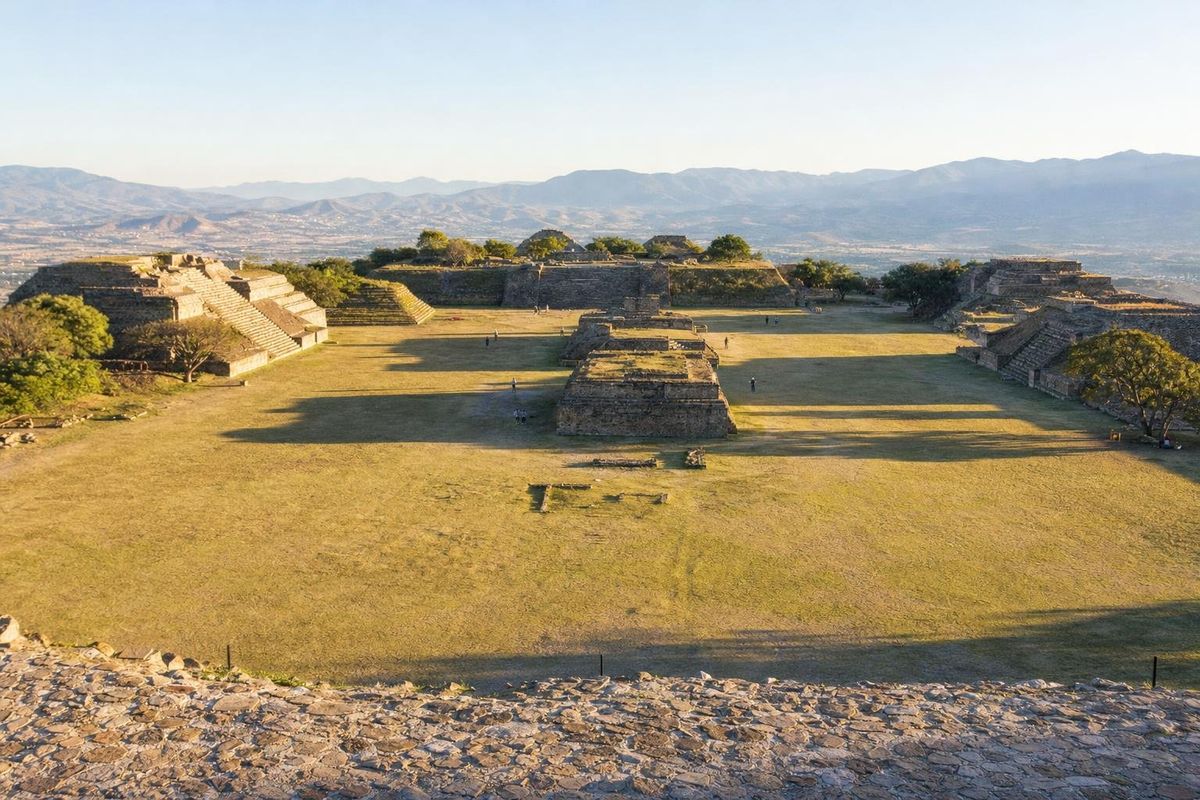
Monte Albán is the ruined capital of the ancient Zapotecs, built on a mountaintop about 10 km west of Oaxaca city and roughly 400 meters above the valley floor. Founded around 500 BC and occupied as a major city for more than a thousand years, it is one of the oldest cities in Mesoamerica, and together with Oaxaca's historic center it is a UNESCO World Heritage Site.
A capital on a flattened mountain
The city's founders chose a ridge where three valleys meet, a site with no permanent water source but a commanding view in every direction. They leveled the summit by hand, cutting rock and filling hollows, to create a platform for a great plaza. Archaeologists generally see the founding as a political act: communities from around the valley came together, or were brought together, in a new, defensible center from which a Zapotec state grew.
Monte Albán's history is divided into phases, from Monte Albán I to V. At its height in the Classic period, roughly AD 200 to 700, the city spread over the hilltop and the terraced slopes around it, and estimates of its population often run into the tens of thousands. Its rulers had contacts with distant Teotihuacan in central Mexico, recorded in carved stones at the site. From around AD 700 to 800 the city declined as a political center, and power shifted to smaller towns in the valley such as Mitla. Later, Mixtec groups reused some of the old tombs.
The archaeologist Alfonso Caso led major excavations here from the 1930s, and most of what visitors see was cleared and consolidated in the decades after.
What to look for at Monte Albán
The Great Plaza is about 300 meters long and 200 meters wide, aligned roughly north to south and closed at each end by a large platform. The buildings below are the highlights; a standard route circles the plaza clockwise from the entrance.
The Ball Court
Near the entrance on the east side, the I-shaped ball court has sloping side walls and no stone rings, unlike the Maya courts farther east. Compare it with the courts described on the page about ballplayers in ancient art.
The Danzantes
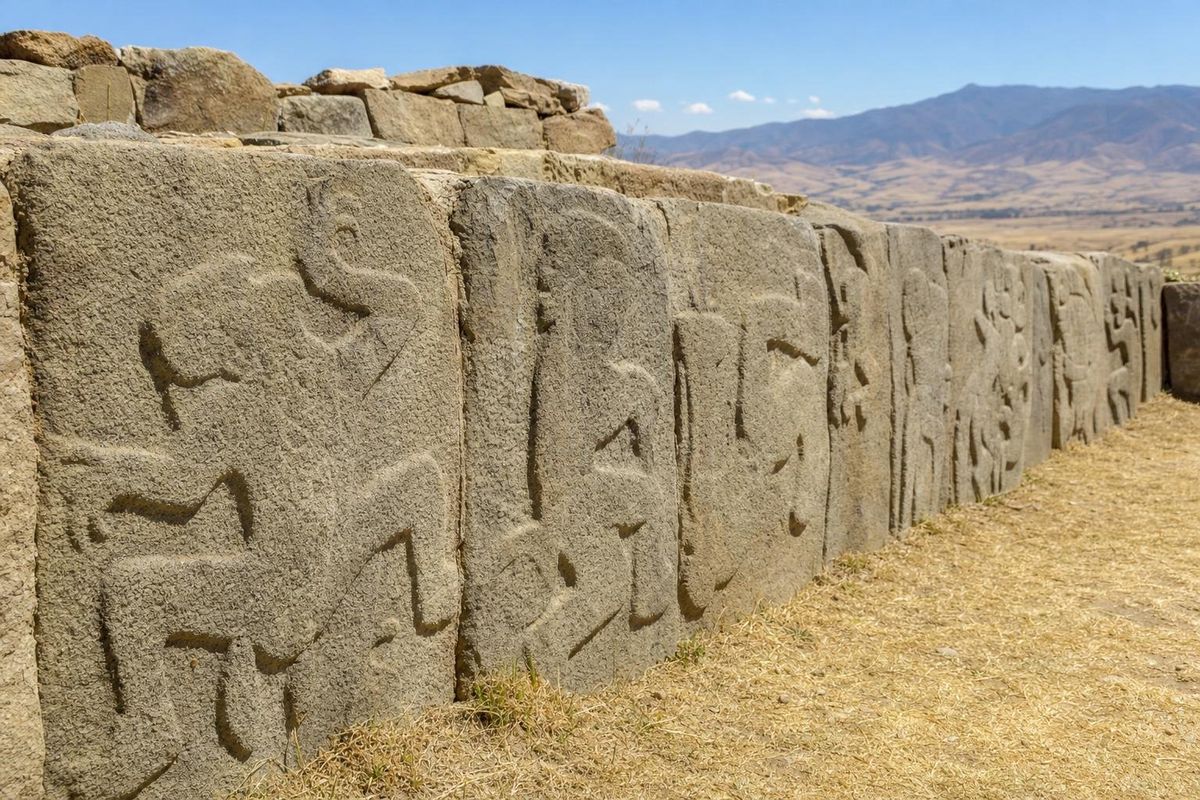
Along the southwest side of the plaza, the Building of the Danzantes (Building L) is faced with carved stone slabs showing naked male figures in contorted poses. Early explorers took them for dancers, hence the name. Most scholars now read them as captives or slain enemies, displayed as a record of conquest, and some slabs carry early glyphs. They are among the oldest carvings at the site. Many originals have been moved to the site museum and replaced with replicas. The page on the Zapotec dancers looks at the interpretations in more detail.
Building J
In the middle of the plaza, Building J stands out: its arrowhead shape points southwest and it is set at an angle to everything around it. Its walls carry slabs with an upside-down head beneath a place glyph, often interpreted as a list of conquered towns. The orientation has led to theories about astronomical sightlines, possibly toward the rising of certain bright stars; these remain theories.
The North and South Platforms
The South Platform is the tallest structure, and its top gives the classic view down the length of the plaza. The North Platform, a vast raised complex with a sunken patio and the bases of large columns, was likely the seat of the city's elite and its main ceremonies.
The tombs
More than 170 tombs have been recorded at Monte Albán. The most famous, Tomb 7, was found by Caso's team in 1932, filled with offerings placed when Mixtec people reused an older Zapotec tomb: gold jewelry, carved jaguar and eagle bones, turquoise mosaic, rock crystal and pearls. That treasure is displayed in the Museo de las Culturas de Oaxaca, in the former convent of Santo Domingo in Oaxaca city. Tomb 104, with painted walls and a Zapotec funerary urn above its doorway, is one of several tombs that are opened to visitors only occasionally.
| Phase | Approximate dates | What happened |
|---|---|---|
| Monte Albán I | about 500 to 100 BC | Founding, leveling of the summit, early Danzantes carvings |
| Monte Albán II | about 100 BC to AD 200 | Expansion across the valley, Building J |
| Monte Albán IIIA and IIIB | about AD 200 to 700 | Classic peak, contacts with Teotihuacan, most of the plaza buildings |
| Monte Albán IV | about AD 700 to 1000 | Decline as a capital, power shifts to valley towns |
| Monte Albán V | about AD 1000 to 1521 | Mixtec reuse of tombs, including Tomb 7 |
Phase boundaries differ slightly between publications; the table follows the commonly used sequence.
Getting to Monte Albán
The site is reached by a winding road that climbs from the western edge of Oaxaca city; by car or taxi the trip takes roughly 20 to 30 minutes. Shuttle buses run from the city center to the site during the day, and many tours include it. Schedules and departure points change, so check locally.
Two craft villages sit at the foot of the mountain: Santa María Atzompa, known for green-glazed pottery and with its own small archaeological site, and San Antonio Arrazola, one of the villages where painted wood carvings are made (see San Martín Tilcajete for the other).
Practical notes
- Monte Albán is managed by INAH. Hours and fees change; check the site's UNESCO listing for background and confirm opening times locally.
- There is almost no shade on the plaza. Arrive at opening time for cooler air, soft light and fewer groups.
- Bring water, a hat and sunscreen, and shoes with grip for the steep stairs.
- Allow two to three hours, plus time for the site museum near the entrance, which holds many of the original Danzantes slabs.
- Pairing the visit with the Museo de las Culturas de Oaxaca in the city, where Tomb 7's treasure is shown, makes both more rewarding.
More Mesoamerican sites, from Oaxaca to the Yucatán, are in the ruins section.
Monte Albán questions
How old is Monte Albán?
It was founded around 500 BC and remained a major city until about AD 700 to 800, with later reuse of its tombs.
Who built Monte Albán?
The Zapotecs, whose descendants still live in Oaxaca. Mixtec groups later reused some tombs, including the famous Tomb 7.
How do you get to Monte Albán from Oaxaca city?
By taxi, car, tour or the shuttle buses that run from the city center. The drive up the mountain takes roughly 20 to 30 minutes.
Where is the Tomb 7 treasure?
In the Museo de las Culturas de Oaxaca, housed in the former convent of Santo Domingo in Oaxaca city.
Who are the Danzantes?
Carved stone figures on Building L. They were once thought to be dancers; most scholars now see them as captives or slain enemies.
How much time does Monte Albán need?
Two to three hours for the plaza and platforms, plus time for the site museum.
Nearby on the map
AI-generated image Maya Mysteries · Oaxaca
Zapotec Danzantes
AI-generated image People of Mexico · Oaxaca
Zapotec pottery
AI-generated image People of Mexico · Oaxaca
Zapotec art
AI-generated image Towns & Villages · Oaxaca
San Bartolo Coyotepec