
−20 m · Stone · Maya Ruins · Chiapas
Palenque Ruins in Chiapas: Pakal the Great, His Tomb and the Lost City
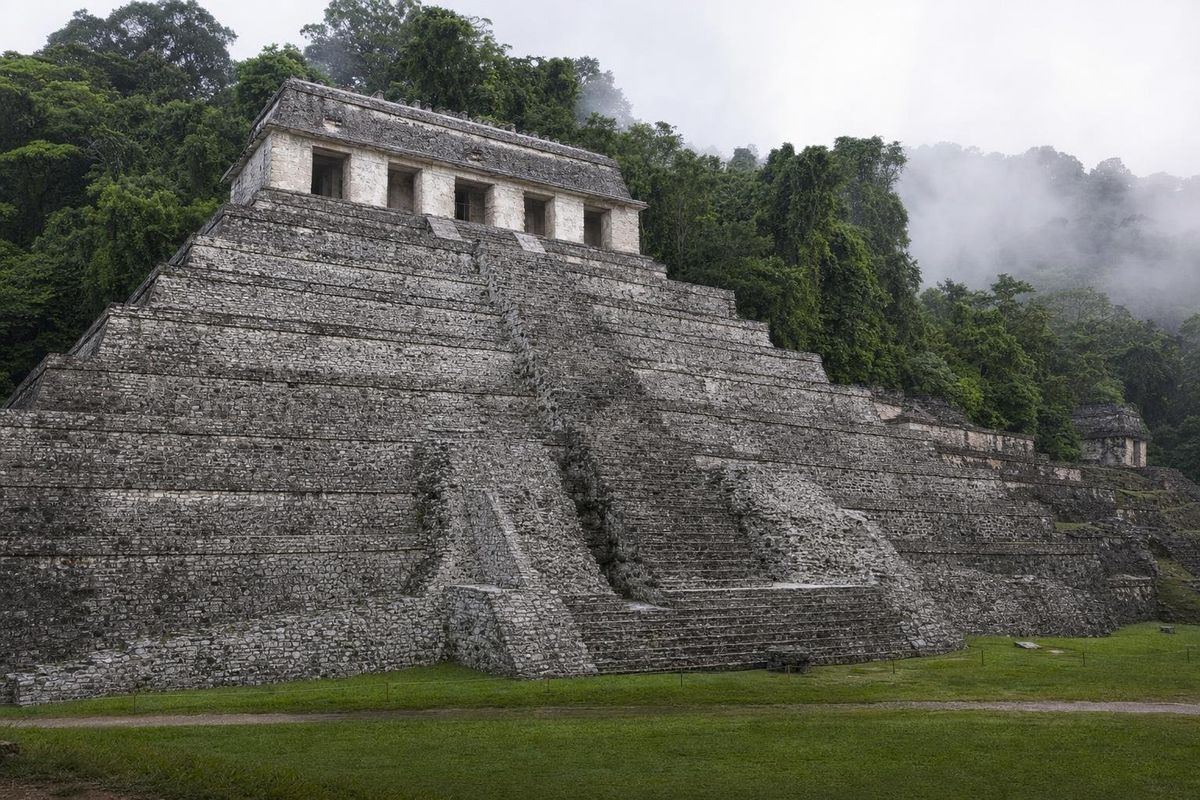
Palenque lies on a forested ridge at the foot of the Chiapas mountains, about 8 kilometers from the town of the same name, and it is the Maya city where the history of a royal family can be read most completely. Its best-known ruler, Pakal the Great, reigned for 68 years and was buried inside the Temple of the Inscriptions under a carved stone lid that has become one of the most discussed objects of the ancient Americas. The Palenque ruins are smaller than Tikal or Calakmul but richer in sculpture, stucco and readable texts.
What the name Palenque means
Palenque is Spanish for "palisade" or "stockade", and it comes from the colonial town nearby, not from the Maya. The inscriptions call the city Lakamha, "big water", a good name for a place crossed by streams that fall off the ridge in a series of pools and cascades. The kingdom it ruled was known as Baakal, "bone". The modern name stuck after the ruins became known to the Spanish authorities in the eighteenth century.
A dynasty in stone
Settlement at Palenque goes back several centuries before the Classic period, but the city's texts begin with a dynastic founder, K'uk' Bahlam, who came to power in 431. For the next two centuries Palenque was a regional kingdom, and twice, in 599 and 611, it was attacked and sacked by the powerful Kaanul dynasty, based at Calakmul. Women held power in this period too: Lady Yohl Ik'nal ruled in her own right in the late sixth century, and Pakal's mother, Lady Sak K'uk', appears to have governed for a few years before he was old enough.
K'inich Janaab Pakal took the throne in 615 at the age of twelve and died in 683, around eighty years old. His long reign turned a damaged kingdom into one of the leading courts of the western Maya lowlands. His son K'inich Kan Bahlam built the Cross Group, and later rulers added more temples, but the city's fortunes changed after it was defeated by Toniná in 711. Monumental building faded in the eighth century, and by around 800 the court had gone silent.
Much of this history was pieced together in the 1970s. At the first Palenque Round Table in 1973, a small group of researchers including Linda Schele, Floyd Lounsbury and Peter Mathews worked out a list of Palenque's kings from the inscriptions, an early breakthrough in reading Maya writing. Simon Martin and Nikolai Grube later set the dynasty in its wider political context.
Pakal the Great and his sarcophagus lid
In 1949 the Mexican archaeologist Alberto Ruz Lhuillier noticed that a floor slab in the temple on top of the Temple of the Inscriptions had holes for lifting. Beneath it was a stairway packed with rubble, and when it was cleared in 1952 it led down to a vaulted chamber deep inside the pyramid. Inside lay a massive stone sarcophagus with the remains of King Pakal, his face covered by a mosaic mask of jade. The mask is now in the National Museum of Anthropology in Mexico City.
The sarcophagus lid shows the king at the moment of death, reclining on the head of an underworld being. Above him rises the world tree, topped by a celestial bird, with a double-headed serpent across its branches; ancestors appear along the sides of the coffin. Most scholars read the scene as the king falling into the underworld and, like the maize god, about to be reborn. In the 1960s and 1970s popular authors described the same carving as an astronaut at the controls of a spacecraft. That reading has no support among specialists, but it made the lid famous far outside archaeology.
The tomb chamber itself has been closed to visitors for conservation for years; a full-size reproduction of the lid can be seen in the site museum. A small stone tube, the so-called psychoduct, runs from the tomb up the stairway, read as a channel linking the dead king with the temple above.
What to see at the Palenque ruins
The Palace
The largest complex at the site is a maze of galleries, courtyards and rooms built over more than a century. Look for the square four-story tower, unique in Maya architecture and possibly used to watch the sky, the stucco portraits on the piers, and the large carved panels of kneeling captives in the East Court.
The Temple of the Inscriptions
Pakal's funerary pyramid takes its name from three panels in the temple at the top, with one of the longest hieroglyphic texts known from the Maya world. Climbing it is not permitted.
The Red Queen and Temple XIII
Next door, a royal tomb found in 1994 held the remains of a woman whose bones and offerings were covered in red cinnabar. She is known as the Red Queen and is often identified as Ix Tz'akbu Ajaw, Pakal's wife, though that identification is not certain. Her tomb can be glimpsed from a passage inside the temple.
The Cross Group
Across the stream, three temples on a raised plaza (the Temple of the Cross, the Temple of the Foliated Cross and the Temple of the Sun) were dedicated by Kan Bahlam in 692. Each held a carved panel showing the king receiving power, with roof combs still standing above.
The aqueduct and the waterfalls
The Otolum stream runs through a stone-roofed aqueduct beneath part of the main plaza. Downhill, the trail toward the museum passes cascades and pools and unrestored buildings in the forest, with howler monkeys often audible overhead.
Getting there and visiting
The ruins are reached by road from the town of Palenque; colectivos run the short route regularly, and many visitors base themselves in town or along the road to the site, described on the Palenque town page. Villahermosa is roughly two hours away by road, and San Cristóbal de las Casas several hours through the mountains. Opening times and fees change and should be checked locally or on the INAH website; the national park around the site may charge separately.
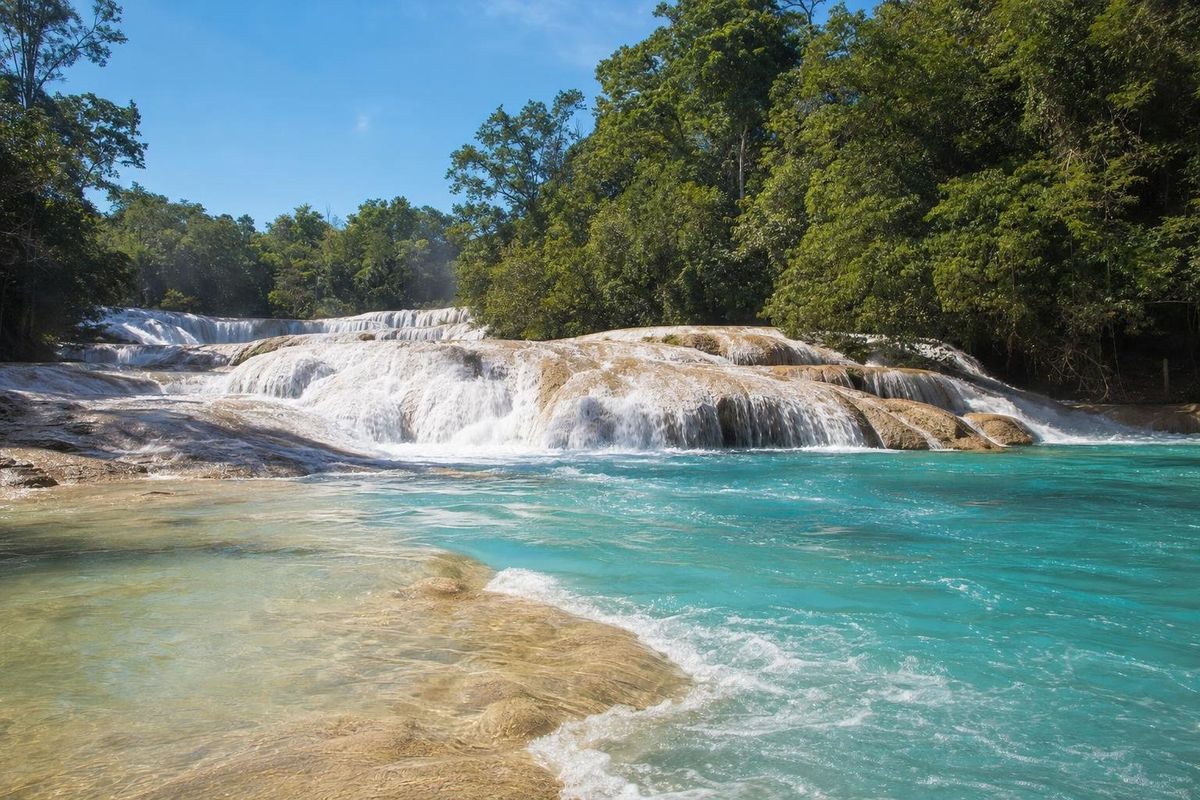
Arrive at opening, when mist often hangs in the trees and it is cooler. It rains heavily here from about June to October, the paths and stairs get slippery, and insect repellent is useful all year. Allow at least half a day for the ruins and the site museum. From Palenque, many travelers continue to Yaxchilán and Bonampak on the Usumacinta, or to the waterfalls at Agua Azul. More sites are listed under Maya ruins.
Palenque: common questions
Who was Pakal the Great?
K'inich Janaab Pakal, king of Palenque from 615 to 683. He came to the throne at twelve, rebuilt the city after its defeats by Calakmul, and was buried in the Temple of the Inscriptions.
What does Palenque mean?
It is Spanish for "palisade" or "stockade", taken from the nearby colonial town. The city's Maya name was Lakamha, "big water".
Can you see Pakal's tomb?
The tomb chamber inside the pyramid has been closed to the public for conservation for years. A full-size replica of the sarcophagus lid is displayed in the site museum.
Is the sarcophagus lid an astronaut?
No. Specialists read it as the dead king descending into the underworld beneath the world tree, ready for rebirth. The astronaut idea came from popular books, not from archaeology.
Who was the Red Queen of Palenque?
A royal woman buried in Temple XIII, her remains coated in red cinnabar. She is often identified as Pakal's wife, Ix Tz'akbu Ajaw, though this is not proven.
How long do you need at Palenque?
Half a day covers the main groups and the museum. A full day allows time for the forest trails and unrestored areas.
Nearby on the map
AI-generated image Towns & Villages · Chiapas
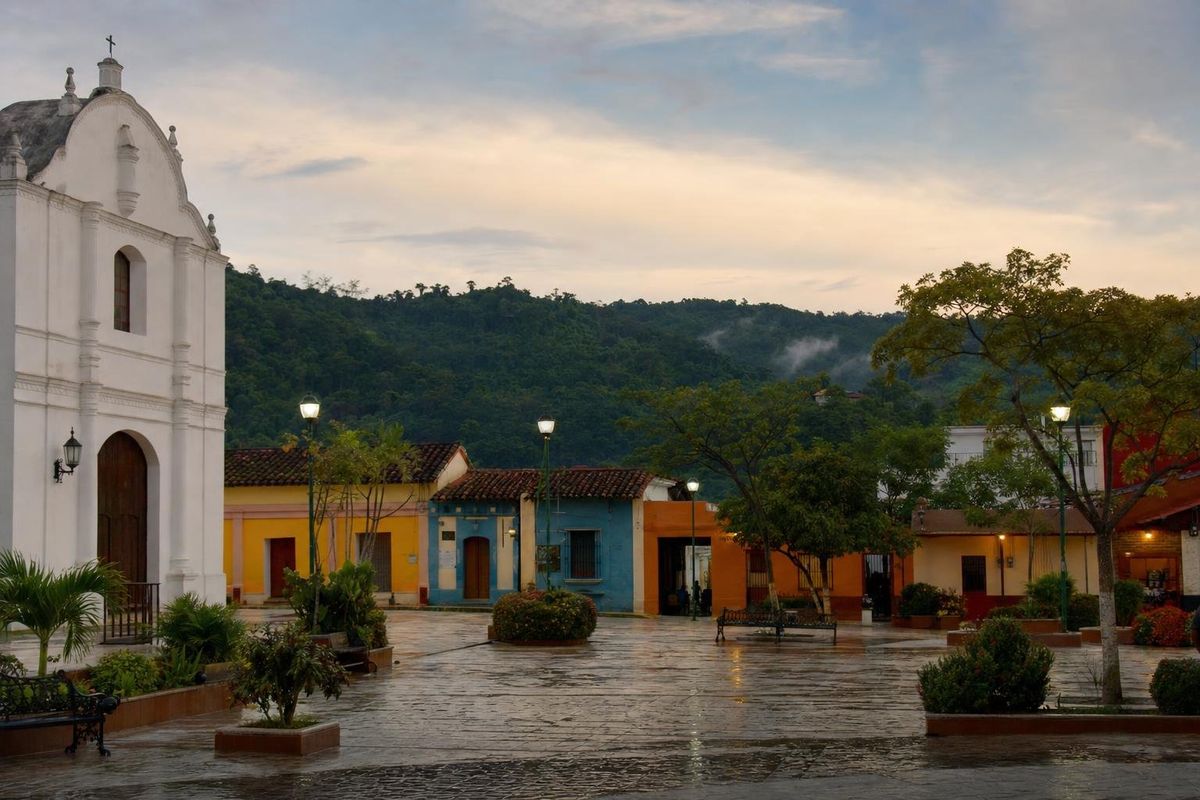
Palenque town
AI-generated image Lakes & Rivers · Chiapas
Agua Azul
AI-generated image People of Mexico · Chiapas
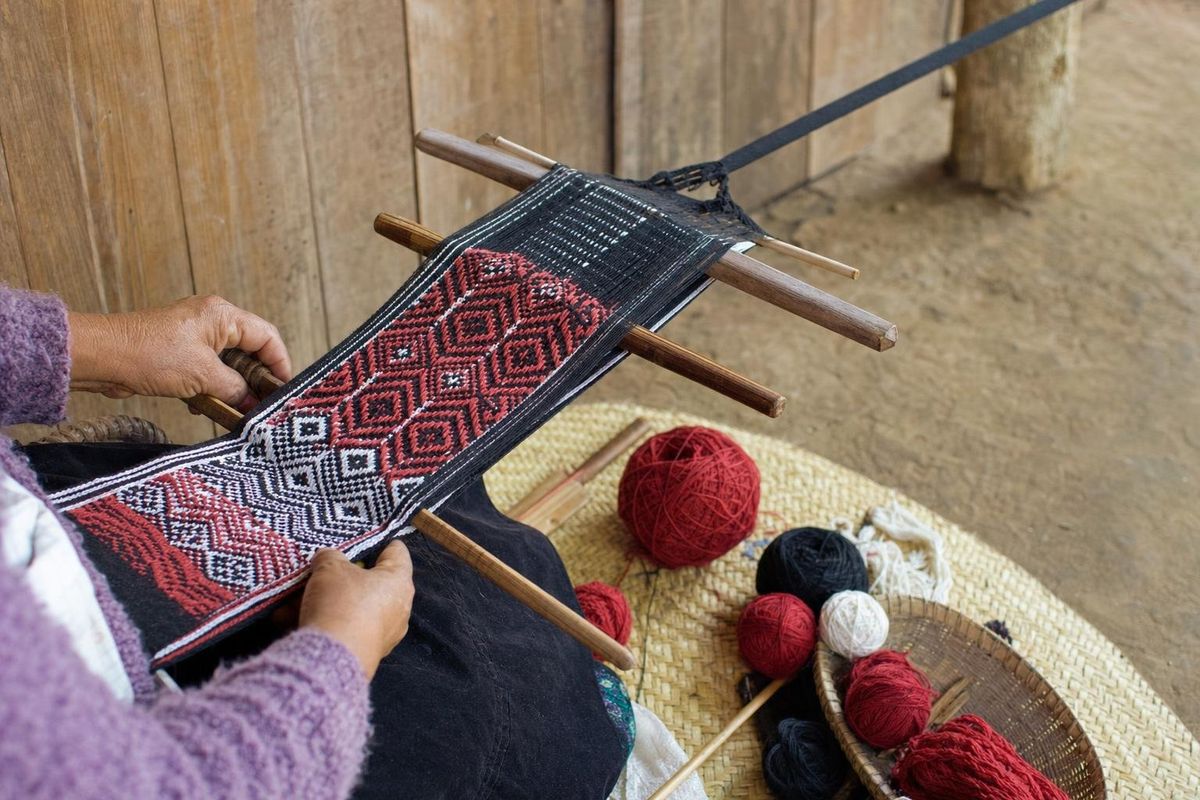
Tzotzil weaving
AI-generated image Towns & Villages · Chiapas
Zinacantán