
−5 m · Shallows · Museums · Mexico City
Diego and I: the Studio-House of Diego Rivera and Frida Kahlo
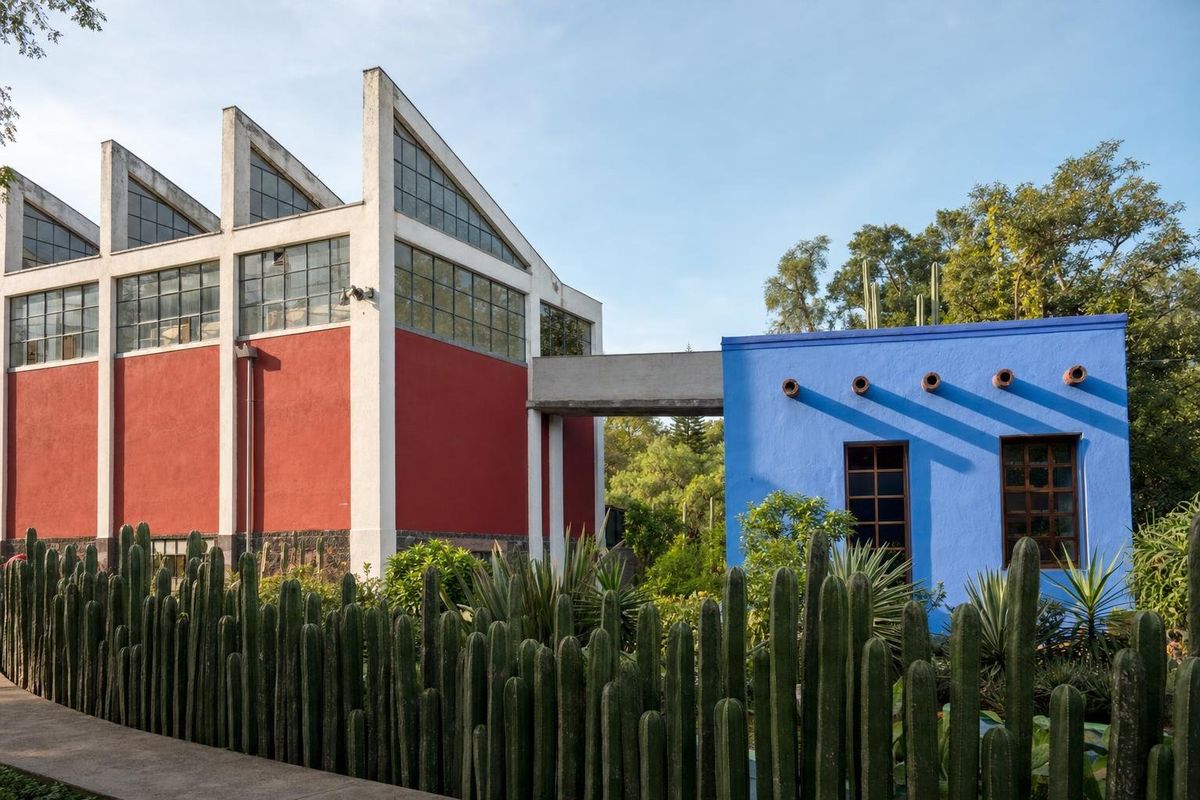
In San Ángel, in the south of Mexico City, two small houses stand behind a fence of organ cacti: a red-and-white one built for Diego Rivera and a blue one built for Frida Kahlo, joined at roof level by a narrow bridge. The couple lived and worked here on and off from 1934, and much of the strain that later surfaced in Kahlo's 1949 painting Diego and I was played out between these two buildings. Today the complex is a public museum, quieter than Kahlo's Blue House in Coyoacán.
Two houses for one marriage
Rivera commissioned the project in 1931 from Juan O'Gorman, a young architect and painter who had already built himself a functionalist house next door. Following the principles Le Corbusier had set out, O'Gorman put the houses on columns, used concrete with nothing hidden, left pipes and wiring exposed, and gave both studios walls of glass. Water tanks, stairs and drains were treated as part of the design. He added a Mexican layer of his own: strong colour, a cactus fence instead of a wall, and a sawtooth roof on Rivera's studio to pull in north light.
Neighbours in San Ángel, then a district of colonial mansions and walled gardens, were not impressed. The houses looked like small factories, and that was more or less the point. They were among the first functionalist buildings in Mexico and helped set off a long argument about what modern Mexican architecture should look like.
Rivera and Kahlo moved in after returning from the United States in late 1933. Each had a separate house with a studio and private rooms, and the rooftop bridge was the link. It was here, around 1934 and 1935, that Kahlo learned of Rivera's affair with her younger sister Cristina, and she moved out for a time. Accounts of the period describe the bridge door on her side being kept locked. The couple divorced in 1939, remarried in San Francisco in 1940 and later settled at the Blue House, but Rivera kept the San Ángel studio as his workplace until he died there in November 1957.
Frida and Diego in the blue house
Kahlo's house is the smaller of the two, and steep: stairs from the ground floor, more stairs to the bedroom, then a ladder-like flight to the roof terrace and the bridge. She lived with lasting injuries from a bus accident in 1925 and the after-effects of childhood polio, which makes the layout hard to imagine as daily life. Few of her belongings remain, since she took them to Coyoacán. What survives is the space itself: a small kitchen, the bathroom with its tub, the studio where she worked in the mid-1930s, and the rooftop.
The bathroom is usually linked to What the Water Gave Me (1938), in which her feet poke out of bathwater filled with floating scenes from her life. Visitors often look for the painting's viewpoint in the tub. Whether she painted it here or only drew on the memory is not certain, but the connection is widely repeated.
Diego's studio and its collection
Rivera's house is larger and the studio, two storeys high with glass along one side, is the heart of the visit. He painted many of his easel works here, while the big murals were done on site in public buildings. The room is set up roughly as he left it: an easel, brushes and pigments, and a collection that tells a lot about his taste. Giant papier-mâché Judas figures, the kind burned during Holy Week, stand among skeletons, masks and pre-Hispanic pieces. Rivera championed these folk crafts as art at a time when educated Mexicans looked to Europe, and similar skeleton figures turn up in his murals.
Exhibition rooms on the lower floors change regularly, with photographs, letters and work by Rivera, Kahlo and their circle. Guests in the 1930s and 1940s included the surrealist André Breton and the actress Dolores del Río.
Diego and I: the painting behind the name
Diego and I (in Spanish Diego y yo) is a small self-portrait Kahlo painted in 1949, by which time the couple were living in Coyoacán. Her hair is wrapped around her neck, tears run down her face, and a portrait of Rivera sits on her forehead like a third eye. Biographers usually read it against Rivera's well-publicised attachment to the film star María Félix at the time. The painting is in a private collection and does not hang in the San Ángel museum; in 2021 it set an auction record for a work by a Latin American artist. Its theme, though, is the same one the studio-houses make physical: two people bound together who kept separate rooms.
Finding the house in San Ángel
The museum stands at the corner of Avenida Altavista and Calle Diego Rivera, a short walk from the cobbled plazas of San Ángel. From central Mexico City the simplest options are a taxi or ride-hail car; the area can also be reached by Metrobús along Avenida Insurgentes followed by a walk of about 15 minutes. On Saturdays San Ángel holds an art market in Plaza San Jacinto, which makes the end of the week a good time to combine the two.
The museum is part of the national fine arts institute's network. Opening days and hours change, and it usually closes one day a week, so confirm before going. Photography rules also vary; some rooms have allowed photos without flash, others not.
Before you go
An hour is enough for both houses. The stairs are steep and narrow, with no lift, which is worth knowing for anyone with limited mobility. Rivera's birthplace, now the Diego Rivera house-museum in Guanajuato, covers his childhood and early work, and Kahlo fans on the Caribbean coast will find a reproduction-based Frida Kahlo museum in Playa del Carmen. For a longer stay in the capital region, the trip around Mexico City links the city with Teotihuacán and the colonial towns to the north. Other house-museums and galleries are listed under museums.
On the way out, look at the fence from the street side. O'Gorman planted a row of organ cacti where every neighbour had a stone wall, and the cacti are still growing there.
Questions about the studio-house
Is this the same as Frida Kahlo's Blue House?
No. The Blue House (Casa Azul) is in Coyoacán, where Kahlo was born and died. The San Ángel studio-houses were built for the couple in the early 1930s and are a separate museum a few kilometres away.
Can you see the painting Diego and I here?
No. The 1949 self-portrait is in a private collection. The museum shows the house, studios, personal objects and changing exhibitions.
Who designed the houses?
Juan O'Gorman, a Mexican architect and painter, designed them in 1931 following functionalist principles. His own earlier house stands on the same property.
Why did Frida and Diego live in separate houses?
The design gave each artist a private studio and living space, linked by a rooftop bridge. It suited two working painters and a marriage that was often strained.
How long does a visit take?
About an hour for both houses and the exhibition rooms. Add time to walk around San Ángel afterwards.
Nearby on the map
AI-generated image Maya Mysteries · Mexico City
Dress and Ahuianime
AI-generated image Trips · Central Mexico
Around Mexico City
AI-generated image Maya Mysteries · Estado de México
Goggles
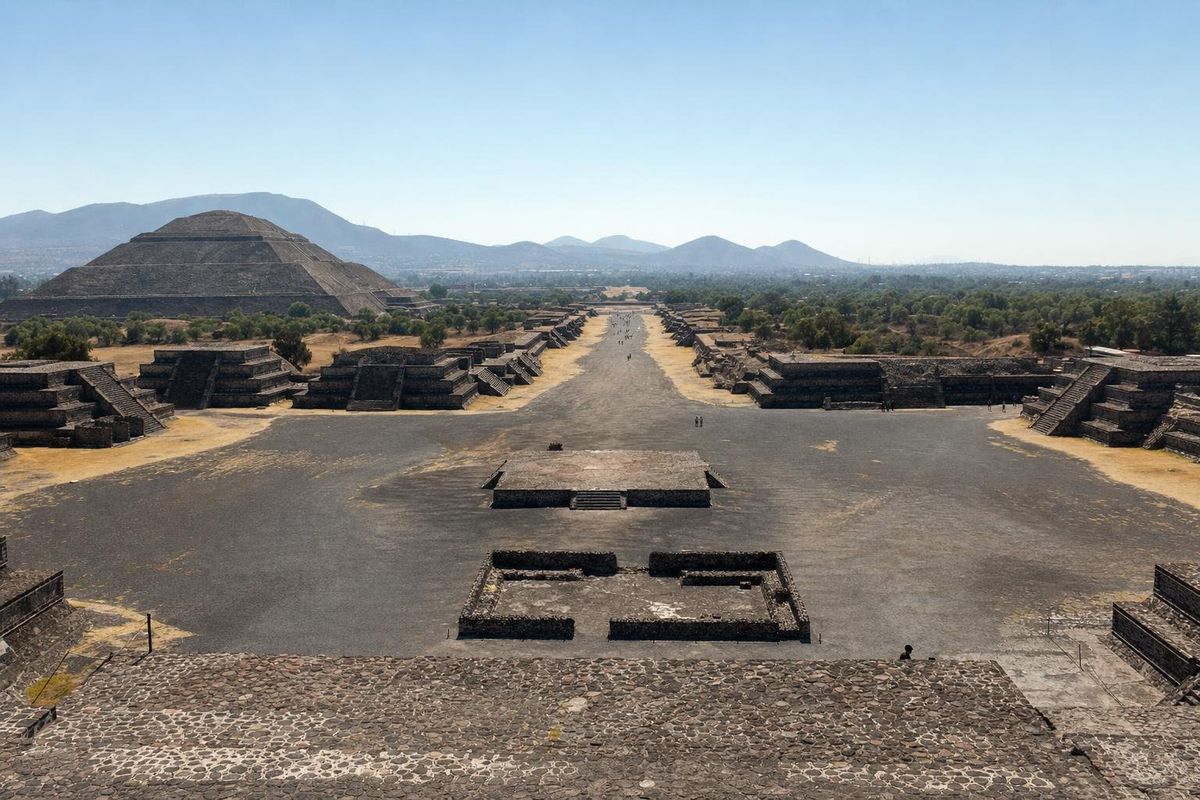
AI-generated image Maya Ruins · State of Mexico
Teotihuacán