
−5 m · Shallows · Haciendas · Cuba
Manaca Iznaga: a Sugar Plantation Tower in Cuba's Valley of Mills
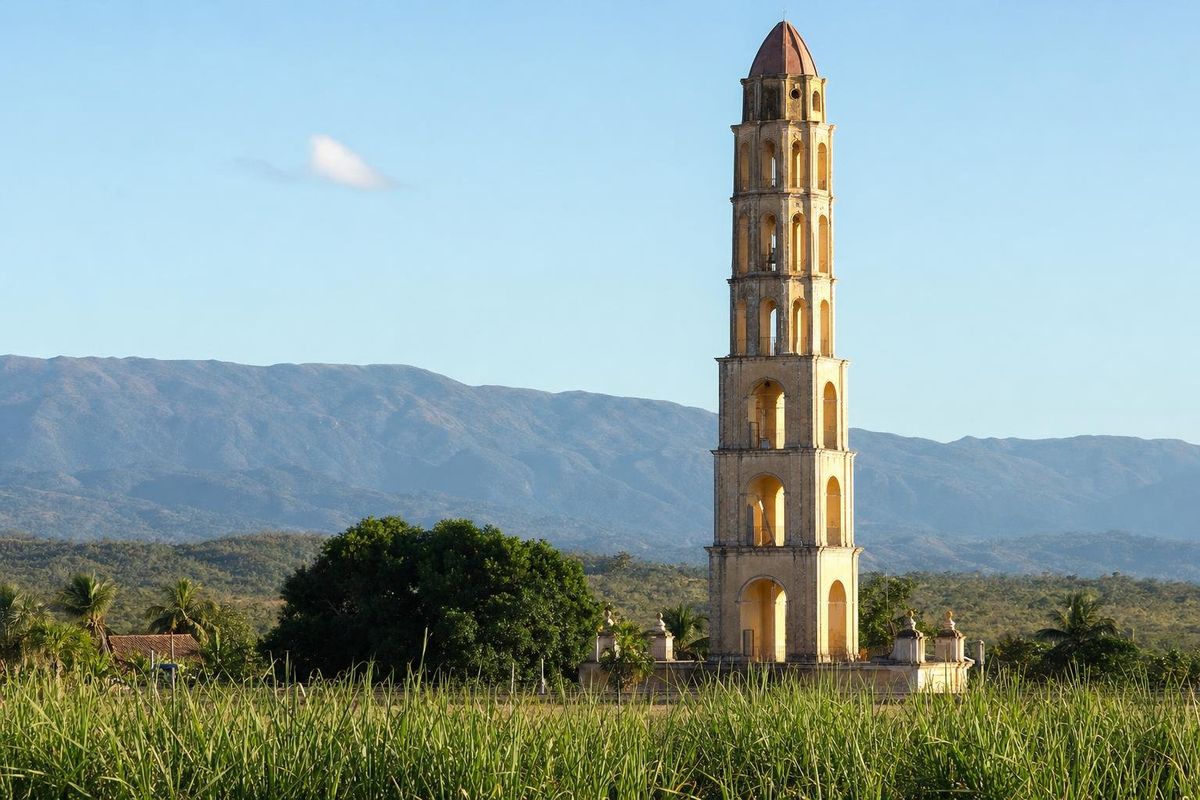
Manaca Iznaga is a former sugar estate in the Valle de los Ingenios, about 15 km northeast of Trinidad in central Cuba, best known for a slender tower roughly 45 metres high built by the Iznaga family in the early 19th century. From its top the planters could survey the cane fields and the enslaved people who worked them. The tower, the family's main house and the village that grew from the old estate are the most visited stop in a valley that was once one of the richest sugar districts in the world.
The valley of the sugar mills
The Valle de los Ingenios is really a group of three connected valleys, San Luis, Santa Rosa and Meyer, running inland from Trinidad toward the Escambray mountains. Sugar cane spread here in the late 18th century, after the Haitian Revolution destroyed the plantations of the neighbouring French colony and left a gap in the world market. By the early 19th century the valley held dozens of sugar mills, more than fifty at its height, and Trinidad's merchant families grew immensely rich.
That wealth rested on slavery. By the late 1820s more than ten thousand enslaved people, most of them born in Africa or descended from people taken from there, worked the valley's estates. Work in the harvest season ran around the clock, and mortality was high. Cuba's sugar plantations became among the most mechanised in the world in the mid-1800s, with steam mills and railways, and the island became the leading sugar producer on the planet. Slavery in Cuba was abolished only in stages, the last in 1886.
The boom in the valley did not last. Soil exhaustion, competition from steam-powered mills elsewhere in Cuba and the destruction of the independence wars in the second half of the century ended it. UNESCO listed the valley together with Trinidad as a World Heritage Site in 1988, for the remains of mills, estate houses, barracks and towers that still dot the fields.
The Iznaga family and the tower
The Manaca estate came into the hands of Pedro José Iznaga, one of the wealthiest men in Trinidad, at the end of the 18th century. His son Alejo María del Carmen Iznaga is credited with building the tower, usually dated to around 1816, although some sources give later years. It rises in seven levels, each a little narrower than the one below, with arched openings on every side.
The tower had practical uses. A bell hung at the top marked the start and end of the working day and the hours of prayer, and lookouts could see fires or watch for people escaping across the fields. It also served as a statement: a landmark visible across the valley that announced the family's wealth. The original bell now rests on the ground near the main house.
The legends
Local storytellers prefer a romance. In the best-known version, two Iznaga brothers competed for the same woman: one built the tall tower, the other dug a deep well, and neither won her. Another tale has a jealous husband building the tower to keep watch on, or lock up, an unfaithful wife. Neither story has documentary support, but guides tell both, and the well beside the estate is pointed out as proof. Some locals also call the structure the Cuban leaning tower, because of a slight tilt.
What to see at Manaca Iznaga
The tower can sometimes be climbed by a narrow wooden staircase to the upper levels, from which the whole valley opens out to the mountains. It has been closed for restoration in some periods, so check locally before planning the climb. The main house, a single-storey building with a long arcaded veranda, has been converted for visitors; it offers a sense of the planters' comfort and a view of the old estate grounds behind. Near it stands an old sugar press, the kind turned by animals to crush cane before steam power arrived.
The village of Iznaga grew from the estate's dwellings and is still home to families who farm and sell to visitors. Its most noticeable feature is the lane to the tower, lined with stalls hung with white embroidered and crocheted tablecloths, blouses and napkins, a needlework tradition strongly associated with Trinidad. Stands sometimes sell guarapo, fresh sugar-cane juice pressed on the spot, which has to be drunk at once before it ferments.
Getting to the Valle de los Ingenios
Trinidad is the base. By car or taxi, the drive to Manaca Iznaga takes around 20 to 30 minutes on the road toward Sancti Spíritus. A tourist train has run from Trinidad through the valley to Iznaga, stopping at viewpoints, but its schedule is irregular and service has been suspended at times, so ask in Trinidad before counting on it. Organised tours often combine Manaca Iznaga with the viewpoint over the valley and the estate of San Isidro de los Destiladeros, where archaeologists have studied the ruins of a mill, a smaller tower and slave quarters.
Many travellers reach Trinidad on the road trip from Havana, which also passes through Santa Clara and the Che Guevara mausoleum. For comparison with Mexico's own plantation history, the henequen estates of Yucatán such as Ochil tell a parallel story of an export crop, a grand house and labour under hard conditions. Other estates and great houses are collected under haciendas.
Practical notes
The valley is hot and open, with little shade along the lane or around the tower. Morning visits are the most comfortable, and a hat and water are essential. Cuba's currency system changed in 2021, when the convertible peso was withdrawn, and the economy has since faced shortages and frequent power and fuel cuts; carry small notes and expect to pay small entry or climbing fees in cash. Rainfall peaks from about June to October, which is also hurricane season in the Caribbean.
The railway that once carried sugar out of the valley still runs past the small station at the edge of the village, a few minutes' walk from the foot of the tower.
Questions about Manaca Iznaga
What was the Manaca Iznaga tower used for?
It served as a lookout over the cane fields and the enslaved workers, carried a bell that marked working hours and prayers, and displayed the Iznaga family's wealth.
How tall is the tower?
About 45 metres, in seven levels. Published figures vary slightly.
Can you climb the Manaca Iznaga tower?
Often, yes, by a narrow staircase, but it has been closed for restoration at times. Check in Trinidad before going.
How far is Manaca Iznaga from Trinidad?
About 15 km, or 20 to 30 minutes by road. A tourist train has also run through the valley, though not always reliably.
Why were there so many sugar plantations in Cuba?
After the Haitian Revolution ended French plantation sugar production in the 1790s, Cuba expanded its own, using enslaved labour and later steam mills. By the mid-19th century it was the world's leading producer.
Nearby on the map
AI-generated image Trips · Cuba
Escape Havana
AI-generated image Museums · Cuba
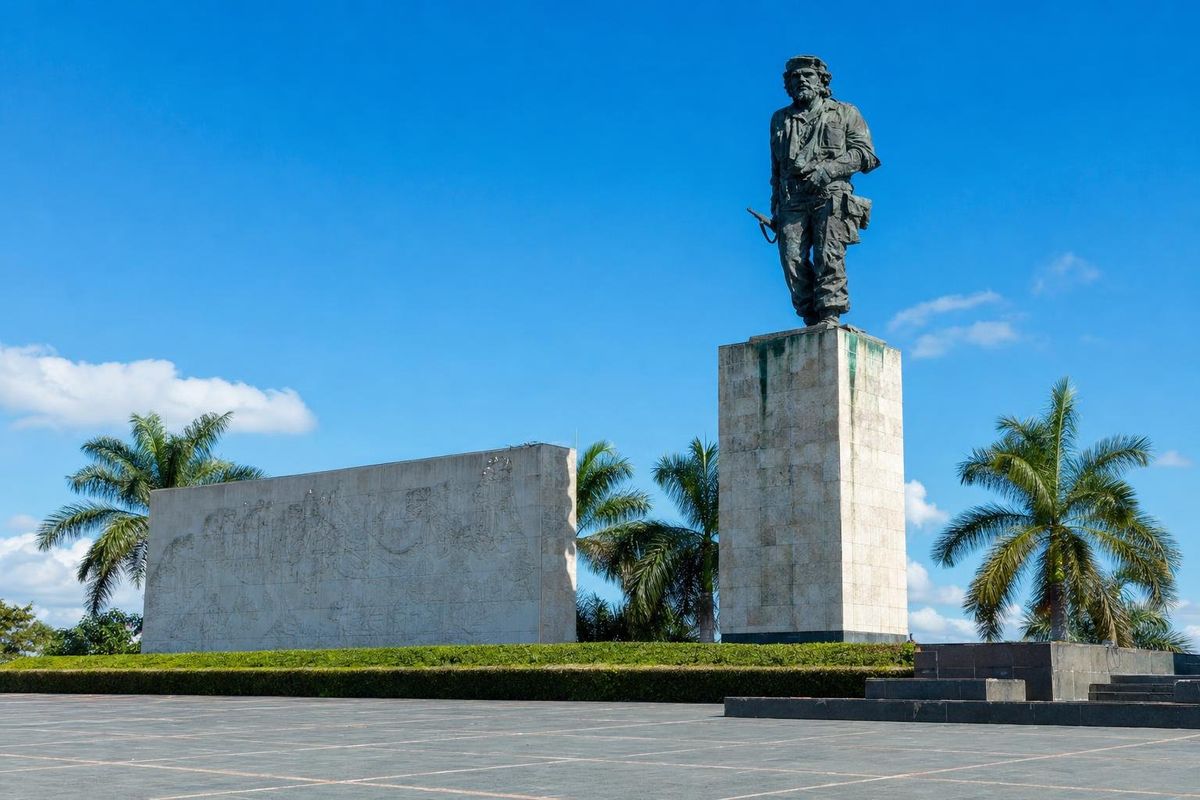
Che Guevara Mausoleum
AI-generated image Islands · Quintana Roo
Isla Mujeres
AI-generated image Beaches · Quintana Roo
Playa Chac Mool